"Should we be on ChatGPT ads" has become a standard agenda item in marketing planning meetings, and most teams answer it with a gut check instead of a real evaluation. That's a mistake in both directions: some brands are skipping a channel that would work for them because it feels unproven, and others are about to spend budget on a channel that literally cannot reach their audience, for reasons that have nothing to do with strategy and everything to do with eligibility rules they haven't checked.
This is a five-step framework for making that call properly, in order, because each step can end the evaluation early. There's no point optimizing your targeting strategy in step three if step one already disqualifies you.
Step 1: Check Whether You're Even Eligible
This is the step most marketing teams skip, and it's the one that ends the conversation fastest. OpenAI currently excludes several categories from advertising entirely, regardless of budget or creative quality: dating, alcohol, tobacco, healthcare, financial services, legal services, gambling, and political content. Eligible categories include household and consumer goods, local services, travel and experiences, and digital products and education.
If your business sits inside an excluded category, stop here. The rest of this framework doesn't apply to you, and it's not a temporary gap you can wait out with a bigger budget or a better creative brief. Your entire ChatGPT visibility strategy runs through organic citations by default, which actually simplifies your planning: there's no paid-vs-organic tradeoff to weigh, because paid isn't on the table. Put your full effort into answer engine optimization instead, and use Vista's AI citation tracking to measure the one lever you actually have.
Step 2: Does Your Audience Actually Overlap With Ad-Eligible Users?
ChatGPT ads only appear for logged-in adults on the Free tier and the $8/month Go plan. Plus, Pro, Business, Enterprise, and Education subscribers never see an ad, from you or any competitor. This single fact should drive a large part of your decision.
If you sell a consumer product, a low-cost subscription, or anything with a genuinely large free-tier audience, there's real reach here. A meaningful share of your prospects are plausibly on a free ChatGPT account. If you sell enterprise software, professional services, or anything where your actual buyer is the kind of power user who pays for Plus or a Business seat specifically because they use ChatGPT constantly for work, you should expect your addressable ad audience on this platform to be small, possibly negligible.
That doesn't mean skip ChatGPT entirely. It means your investment there should weigh heavily toward earning citations (which every tier sees) rather than buying placements (which only the Free and Go tiers see).
Step 3: Do You Have a Bottom-Funnel, High-Intent Query to Target?
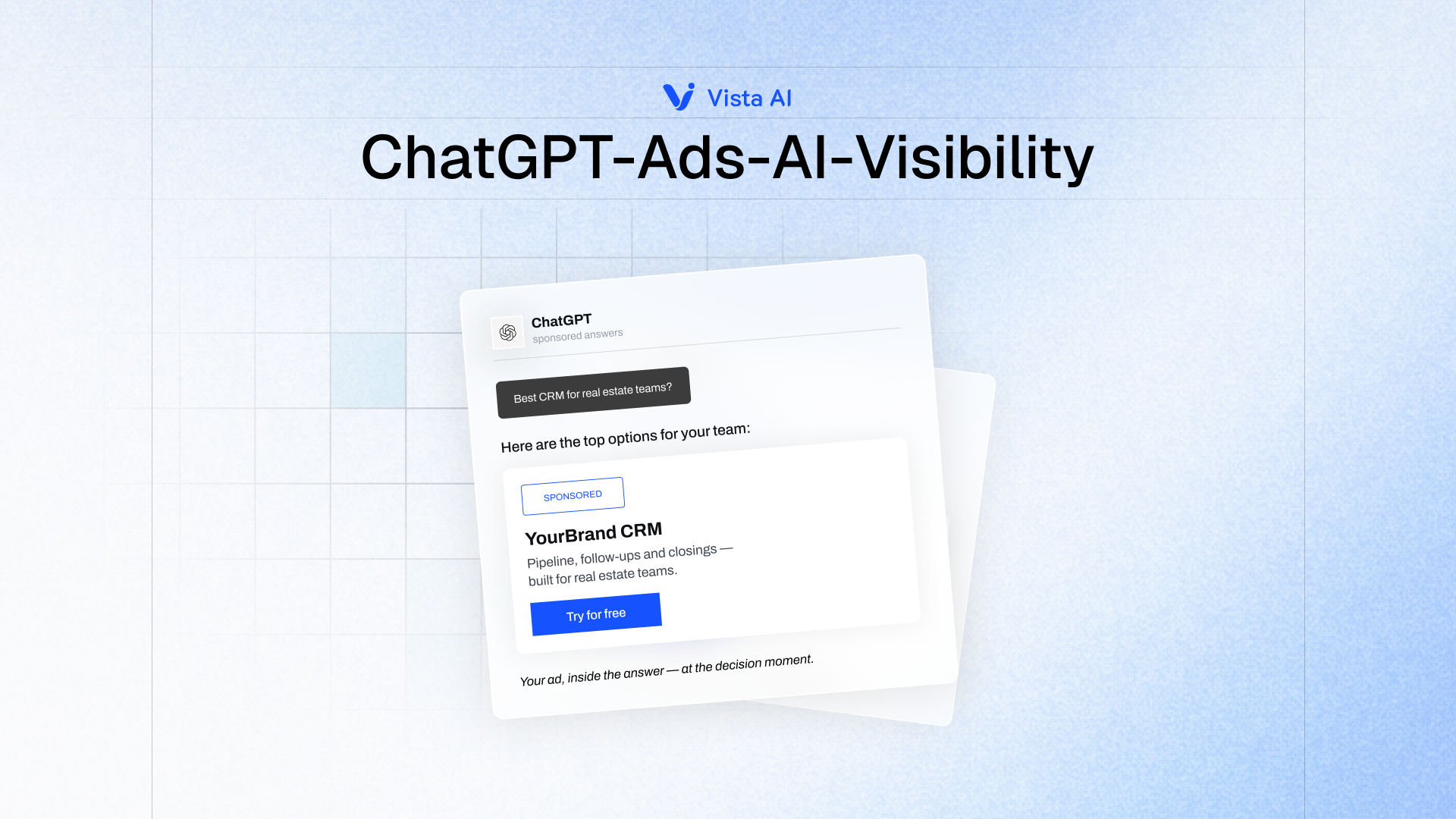
ChatGPT's ad model is contextual. It matches ads to a conversation already in progress, using topic, general location, and language. That rewards specific, high-intent moments far more than broad brand-awareness plays. "Best running shoes for marathon training" is a much better fit for a sponsored product card than "how do I get better at running," even though both are plausible things someone might ask.
Before testing this channel, write down the actual queries you'd want to appear against. If you can list five to ten specific, commercially loaded questions your buyers ask right before choosing a vendor, you have a legitimate targeting starting point. If the best you can come up with is broad category awareness questions, ChatGPT ads are likely to underperform for the same reason broad-match display ads underperform anywhere else: you're paying to interrupt research, not to answer a decision.
Step 4: Can You Actually Fund a Test That Generates Real Data?
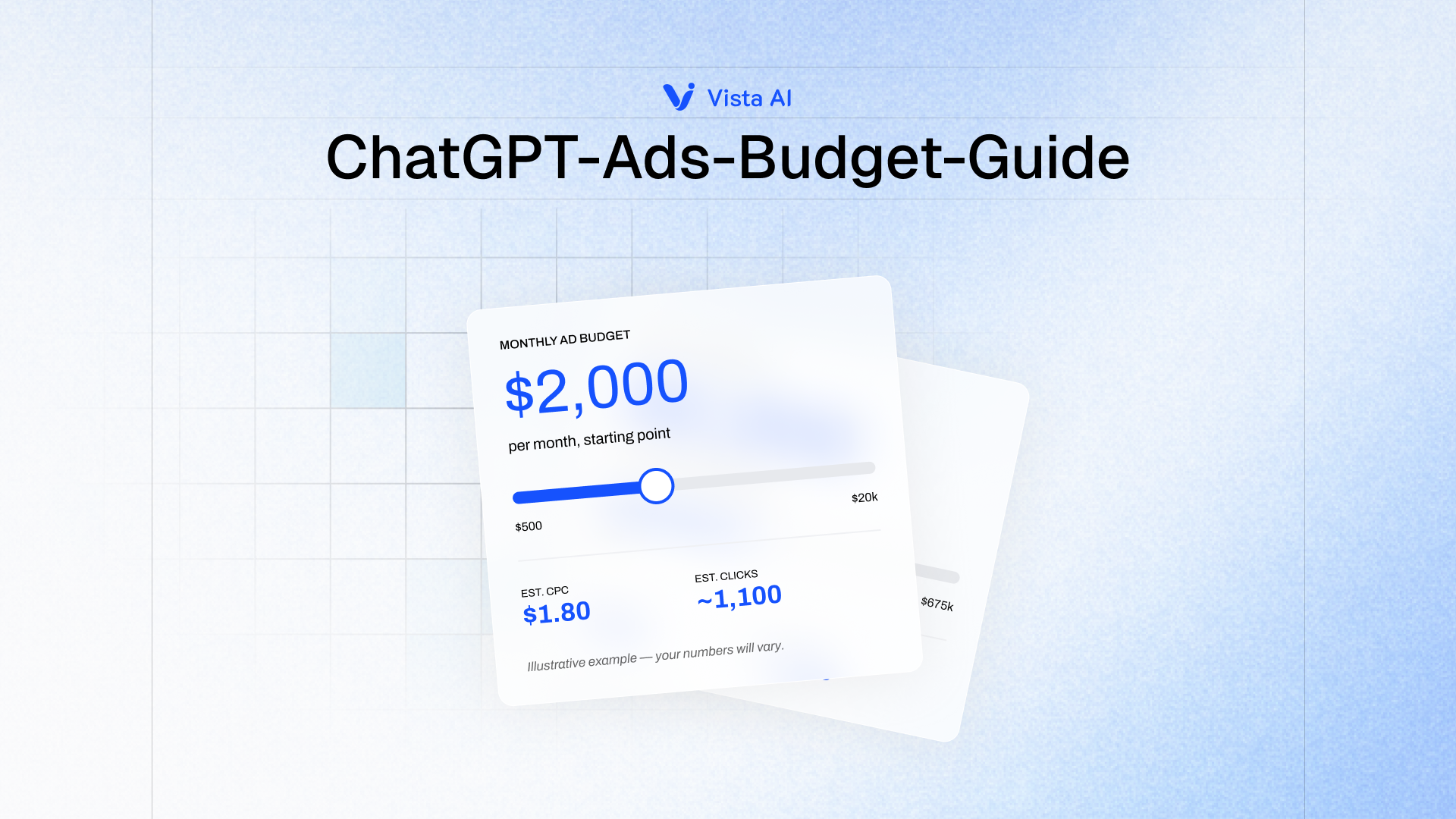
A $25/day minimum technically gets a campaign live, but it doesn't generate enough click volume to learn anything. A realistic test runs $100–$300 per day for about two weeks. See our full ChatGPT ads budget breakdown for the complete pricing picture, including how current CPCs compare to Google and Meta.
If that two-week test budget—roughly $1,400 to $4,200 all-in—isn't available right now, it's better to wait until it is than to run an underpowered test and draw conclusions from noise. A "we tried ChatGPT ads and they didn't work" verdict based on a $25/day budget for three days isn't a real result.
Step 5: Is Your Organic Foundation Already in Place?
This is the step that determines whether an ad, if you run one, actually converts. OpenAI has been explicit that advertising doesn't influence the answer ChatGPT generates the sponsored card sits below a response the model produced independently.
If someone clicks your ad but ChatGPT itself has never mentioned your brand favorably in an organic answer, you're introducing yourself cold, with all the trust-building work still ahead of you. If your brand already shows up as a credible, cited option in the model's own answers, a sponsored click reinforces something the platform has already implicitly endorsed a fundamentally stronger position.
Check this before you spend anything: run a handful of the queries from Step 3 through ChatGPT yourself, or use Vista's brand visibility dashboard to see it systematically. Brands with a weak or nonexistent organic presence generally get more value from redirecting ad budget into AEO first and revisiting paid placement once they have citations to reinforce.
A Simple Scoring Rubric
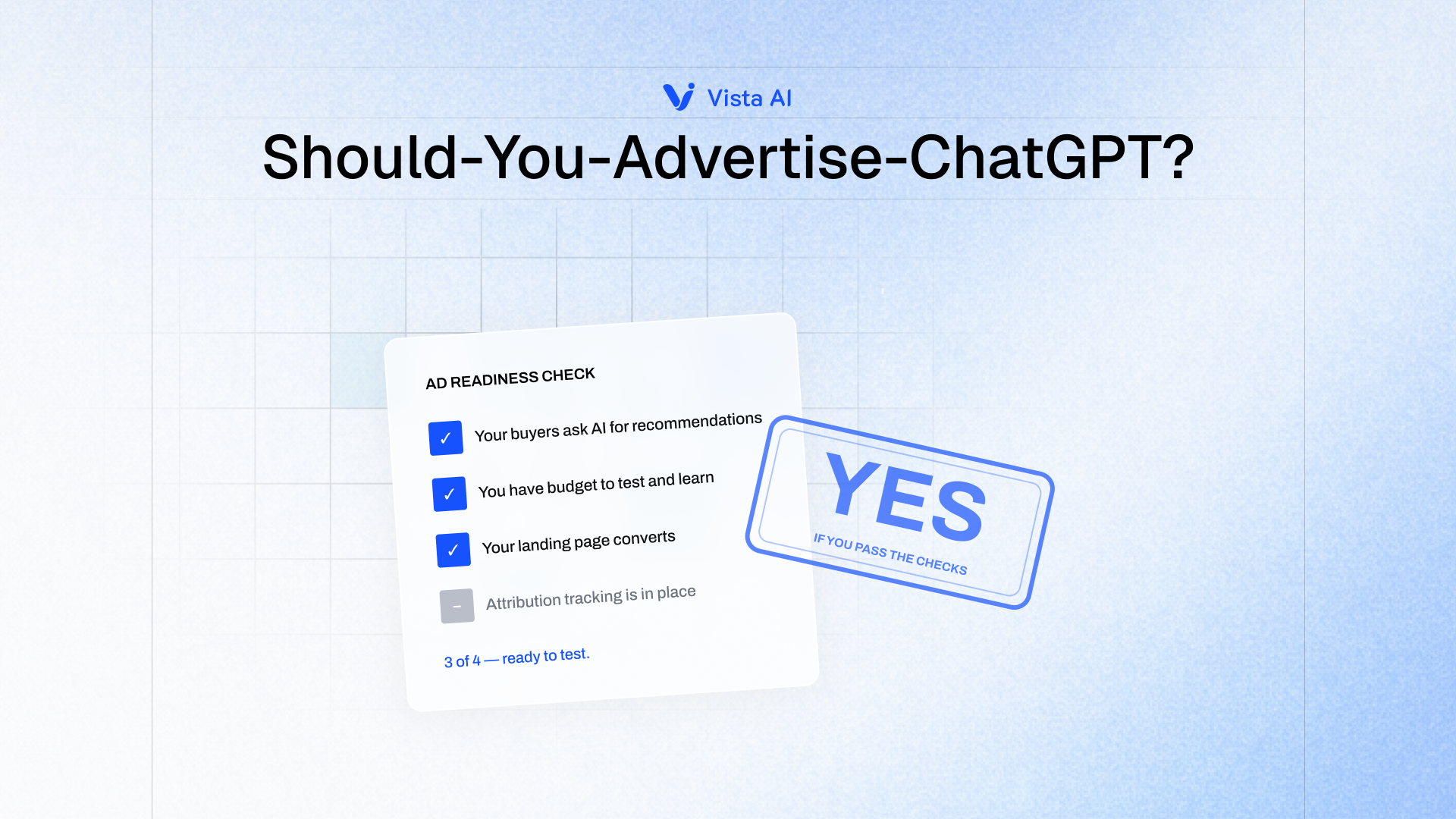
Score one point for each statement that's true for your brand, after confirming Step 1 doesn't disqualify you outright.
| Question | Point if yes |
|---|---|
| My category is eligible to advertise on ChatGPT at all | Required to proceed |
| A meaningful share of my buyers plausibly use the Free or Go tier | +1 |
| I can list 5+ specific, bottom-funnel queries worth targeting | +1 |
| I can fund a genuine $1,400–$4,200 two-week test | +1 |
| My brand already appears in organic ChatGPT answers for my category | +1 |
4 points: Run the test now you have the eligibility, audience, targeting clarity, and organic foundation to get a clean read.
2–3 points: Pilot cautiously, but fix the weakest input first usually the organic foundation (Step 5) or targeting clarity (Step 3) before scaling spend.
0–1 points: Hold off on paid entirely. Put the budget into AEO instead; it addresses the gaps that are also limiting how well an ad would convert anyway.
Three Quick Scenarios
A consumer meal-kit subscription brand: Eligible category, largely free-tier-adjacent audience, clear bottom-funnel queries ("best meal kit for a family of four"), $2,000 test budget available, and a handful of existing organic mentions. Score: 4. Green light for a structured test.
A mid-market B2B project management SaaS company: Eligible category, but its actual buyers are power users on ChatGPT Business or Enterprise seats who never see an ad. Its content targets broad awareness terms rather than bottom-funnel comparisons, and it has no confirmed organic citations yet. Score: 1. This brand should be spending on AEO, not an ad pilot that can't reach its real buyers.
A regional healthcare clinic chain: Excluded category. Full stop at Step 1 no scoring needed, no paid option exists, 100% of the strategy is organic.
How to Run the Test Once You Decide
If you score a 4, or a 2–3 after closing your weakest gap, don't skip straight to launching a campaign. Set up conversion tracking first a distinct UTM parameter for ChatGPT traffic and a clear definition of what counts as a conversion for this test, whether that's a lead form, a demo request, or a purchase before you spend a dollar, since you won't be able to retroactively separate ChatGPT-sourced results from everything else once traffic starts blending together in your analytics.
Write two or three creative variations rather than one, since you have no baseline yet for what performs well in this format, and set your context hints around the specific bottom-funnel queries you identified in Step 3 rather than broad category terms.
Run the full two-week window before making a scale-or-kill decision. A three-day read on a brand-new ad platform is not enough data, even if the early numbers look unusually good or bad.
At the end of the window, compare your blended cost-per-conversion against your existing channels using the same attribution logic, not just the headline CPC, and revisit the scoring rubric itself. A campaign's real-world performance is the most reliable input you'll ever have for steps 2, 3, and 5, so use what you learn to re-score yourself before deciding whether to scale.