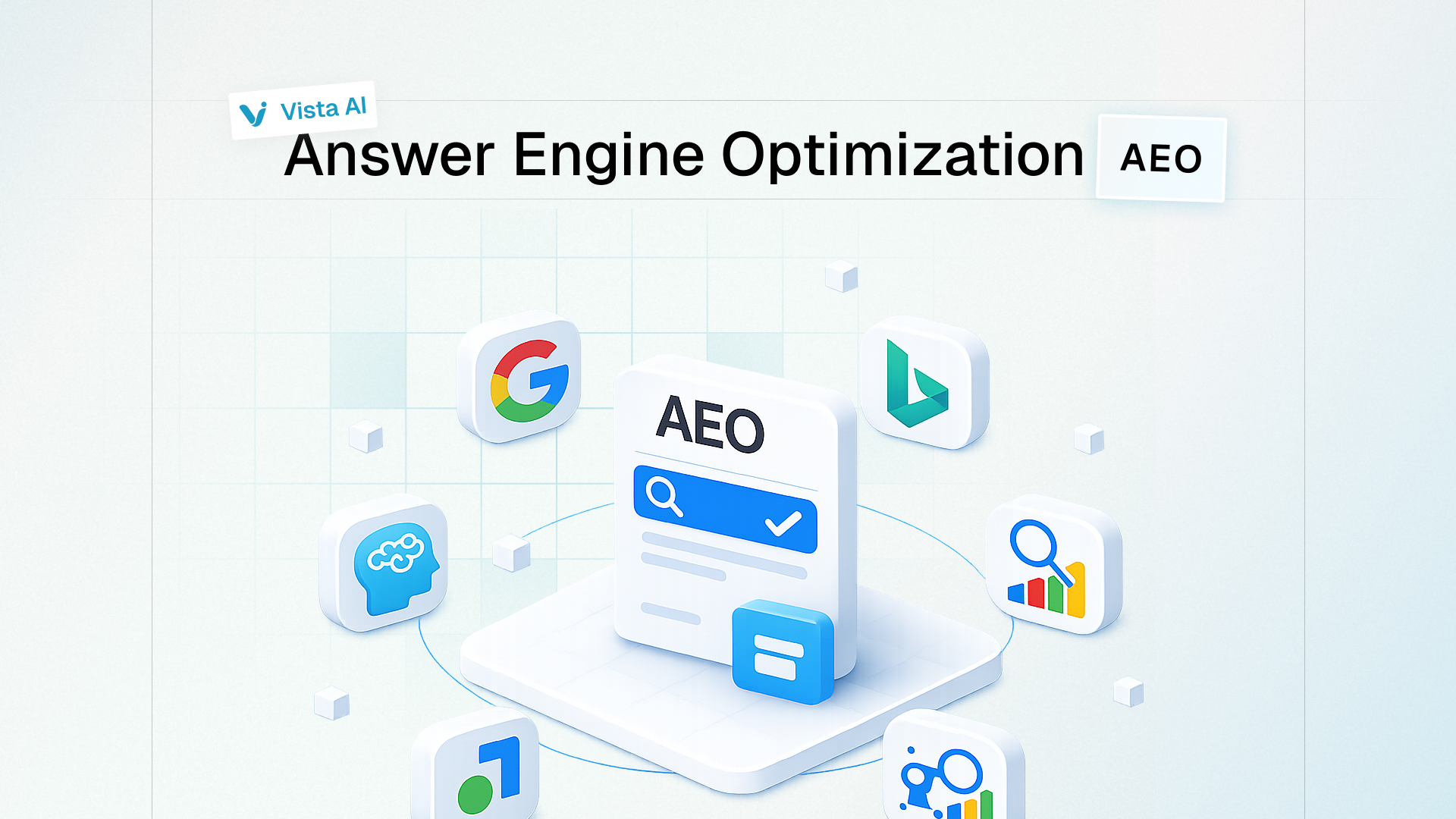
AEO is SEO for LLMs.
Traditional SEO optimizes for Google's algorithm. Answer Engine Optimization (AEO) optimizes for how LLMs source, evaluate, and recommend content. The difference matters more than it sounds: Google shows you ten blue links, but ChatGPT synthesizes an answer and cites only three to five sources. If your content isn't among those three to five, you don't exist to the LLM user, regardless of how well it would have ranked in a traditional search.
This guide covers exactly how to get your content cited by ChatGPT, Claude, Perplexity, and other LLMs, starting with the prompts that LLM users actually ask.
What is Answer Engine Optimization (AEO)?
AEO is the practice of optimizing content so that LLMs cite it when answering user queries. In Google SEO, success comes down to keyword matching, backlinks, page speed, and mobile experience. AEO runs on a different set of signals entirely. Clarity matters because LLMs parse clean, direct language far more reliably than jargon. Structure matters because headings, lists, and well-defined sections are easier for a model to extract from. Original data matters because statistics and examples are the things LLMs most often choose to cite. Authority matters because citations from other trusted sources lend your content credibility, and freshness matters because recently updated content signals that it's still current and worth referencing.
The Three Types of Prompts LLM Users Ask
Understanding user intent is the foundation of AEO, and most prompts fall into one of three categories.
Direct answer prompts are the simplest: "What is answer engine optimization?", "How do I optimize for AI search?", or "Define semantic search." When a user asks one of these, the LLM synthesizes a clear definition, cites two or three authoritative sources, and adds a bit of context. To rank here, your content needs to be the clearest, most authoritative definition available, written in plain language, backed by one compelling example, and ideally marked up with Definition schema.
Comparison and evaluation prompts look more like "What's the best AEO tool?", "ChatGPT vs Claude vs Perplexity, which is best?", or "How do I choose between Semrush and Ahrefs?" Here, the LLM compares several options, lists pros and cons for each, and often makes an outright recommendation. To win this kind of query, build genuine comparison tables that are easy for a model to parse, write specific pros and cons rather than marketing copy, include pricing and feature data the LLM can lift directly, and use clear subheadings for each option being compared. see this structure in practice
How-to and tutorial prompts include things like "How do I implement schema markup?", "Step-by-step guide to AEO optimization," or "How do I set up my site for LLM citations?" For these, the model provides step-by-step instructions and often cites or links to a guide it trusts. Numbered steps, code snippets where relevant, and concrete, actionable instructions (rather than theory) are what earn the citation.
The AEO Optimization Framework
Step 1: Create a clear main claim. Your main claim is a one-sentence explanation of what the content is about, and it needs to live in your H1 and first paragraph. A line like "Exploring the intersection of semantic understanding and language models" tells an LLM nothing useful. A line like "Answer Engine Optimization (AEO) is the practice of structuring content so LLMs cite it in their answers" does the job in plain language. LLMs extract the main claim from your first sentence; if it's vague, they move on to a competitor's page.
Step 2: Structure with semantic headings. Using H2, H3, and H4 headings to show content hierarchy helps an LLM understand how your page is organized and which sections answer which sub-questions. A typical structure might run H1 for the overall topic, H2 sections for "What is AEO?" and "Why AEO Matters," with H3 subsections underneath for specific audiences like SaaS companies or publishers, followed by an H2 on implementation with H3s for content structure and schema markup. The key is a logical hierarchy: headings should be descriptive rather than vague, and you should never drop to an H4 without an H3 above it.
Step 3: Use data, not prose. Replacing dense paragraphs with tables and statistics dramatically improves how easily an LLM can extract your content. A paragraph like "Answer Engine Optimization has become increasingly important over the past year. ChatGPT has grown to over 100 million users, and Claude has seen adoption across enterprise customers. Perplexity is also gaining traction among researchers" is much harder for a model to parse than the same information laid out as data:
| Platform | Monthly Users | Best For | Citation Rate |
|---|---|---|---|
| ChatGPT | 100M+ | General questions | 40% of answers |
| Claude | 50M+ | Complex analysis | 35% of answers |
| Perplexity | 20M+ | Research | 45% of answers |
LLMs extract structured data far more reliably than prose, which is why tables for comparisons, short lists for features, numbered steps for processes, and callouts for key statistics consistently outperform paragraph-heavy writing in this context.
Step 4: Add schema markup. Schema is code that tells LLMs exactly what your content is about. For AEO purposes, the schemas that matter most are Article (basic metadata for any post), FAQPage (for question-and-answer content), HowTo (for tutorials), Product (for tool comparisons), and BreadcrumbList (for site hierarchy). A basic Article schema implementation looks like this:
{ "@context": "https://schema.org", "@type": "Article", "headline": "Answer Engine Optimization (AEO) 101: The Complete Prompt Strategy", "description": "Master Answer Engine Optimization (AEO) for ChatGPT, Claude, and Perplexity.", "author": { "@type": "Organization", "name": "VistaAI" }, "datePublished": "2026-06-12" }
Schema markup functions like a metadata passport: it tells an LLM exactly what the content is about, who published it, and who wrote it. In practice, that means adding Article schema to every post, FAQPage schema to Q&A content, HowTo schema to tutorials, and testing all of it with Google's Rich Results Test before publishing. Run a page audit
Step 5: Include original data and research. LLMs consistently prioritize original sources over summaries of other people's work, so unique insights are one of the highest-leverage things you can add to a page. This might mean survey results pulled from your own customers, analysis of a public dataset, case studies with measurable outcomes, or original research you conducted yourself. Aim to include at least one or two unique statistics per article, and where possible, link directly to the original research, cite real customer case studies, and include your own screenshots or visuals rather than stock imagery.
Step 6: Optimize for readability. Readability and parseability are effectively the same thing from an LLM's perspective. Content that's easy for a human to scan, with sentences in the 15-to-20-word range, paragraphs of two to three sentences, descriptive (not vague) subheadings, plain-language definitions, and one example per concept, is also the content an LLM can most reliably extract and cite.
AEO Prompt Strategies by Content Type
For comparison content, the prompts you're optimizing for look like "Best X tools for Y," "How does X compare to Y?", or "Semrush vs Ahrefs, which is better?" The winning structure starts with a comparison table covering five to ten options, followed by individual sections for each tool with honest pros, cons, and pricing, and closes with a clear recommendation backed by Product schema. A typical layout would run an H1 like "Best AI Search Visibility Tools 2025," an H2 comparison table, individual H2 sections per tool, and a final H2 naming a pick and explaining why.
For how-to content, prompts like "How do I implement X?" or "Step-by-step guide to X" call for numbered steps, screenshots at each stage, code snippets where the topic is technical, an estimated completion time, and HowTo schema. A page titled "How to Implement Schema Markup for AEO" would typically open with prerequisites, then walk through choosing a schema type, adding the JSON-LD, testing it, and monitoring results in Search Console, closing with an estimated time of around 30 minutes.
For definition and explanation content, prompts like "What is X?" or "Explain X to me" reward a direct one-to-two-sentence answer in the opening paragraph, followed by examples, a contrast with related terms, and ideally a visual explanation, all backed by Definition schema. A page like "What is Answer Engine Optimization (AEO)?" would open with a simple definition, follow with a comparison table showing how it differs from SEO, include a real example or case study, and close by explaining why it matters.
Read more about tools and how you can implement these changes
Real Example: Optimizing for the "AEO Prompt" Query
Consider the prompt "What is AEO and how do I optimize for it?" A weak response that's unlikely to get cited reads like vague marketing copy: "Answer Engine Optimization (AEO) is becoming increasingly important as LLMs grow in popularity. Companies need to think about how their content appears in AI-generated answers." It states the topic without ever directly answering the question, and there's nothing here an LLM can extract and cite.
A strong response gets cited far more often because it answers the question immediately, then backs that answer with structured data:
Answer Engine Optimization (AEO) is the practice of structuring content so that LLMs cite it in their answers.
| Aspect | Traditional SEO | AEO |
|---|---|---|
| Goal | Rank in Google | Cited by LLMs |
| Key Signals | Backlinks, keywords | Clarity, structure, data |
| Citation Rate | Not relevant | 2-5 sources per answer |
| Updates | Months | Weeks |
From there, the response can walk through the path to optimization: writing a clear main claim in the H1, structuring the content with semantic headings, replacing prose with tables and lists, adding original data, and including schema markup. The second version is cited more because it directly answers the question, backs that answer with data, and is structured in a way that's trivial for a model to extract and reuse.
AEO Checklist
Before publishing, it's worth running through a short mental checklist rather than a long bulleted one. On content quality, confirm the main claim is answerable in a sentence or two, that headings follow a clean H2 to H3 to H4 hierarchy, that no jargon goes unexplained, and that every key concept has an example attached. On structure, make sure tables are doing the work for comparisons, bullets are reserved for genuine lists, numbered lists are used for sequential steps, and paragraphs stay to two or three sentences. On data and authority, check that original research is included, external citations point to authoritative sources, case studies or examples are present, and the author or brand is clearly identified. Finally, on technical SEO, verify schema markup is in place (Article at minimum, plus FAQPage or HowTo where relevant), the meta description is clear and keyword-rich, internal links point to related content, and images carry descriptive alt text.