You can't optimize what you don't measure.
If you're trying to rank in AI search, you need tools that show you whether LLMs cite your content, how often ChatGPT mentions you versus competitors, how to improve visibility across all AI search engines, and what kind of ROI you're getting in the form of traffic from AI sources.
This guide reviews the best AI search visibility tools for 2025, comparing pricing, features, pros and cons, and the use cases each one fits best.
Why You Need AI Search Visibility Tools (Not Just SEO Tools)
Traditional SEO tools are built to measure Google rankings, traffic potential, and backlinks. AI visibility tools measure something different: LLM citation frequency, AI answer appearances, visibility across ChatGPT, Claude, Perplexity, and Google AI, and traffic arriving from AI sources.
Both matter because they're not interchangeable. Your content can rank #1 in Google and still be invisible to ChatGPT, or it can be heavily cited by Claude while sitting at position #10 in Google. Covering both ecosystems is the only way to get a full picture of your search visibility.
Top 5 AI Search Visibility Tools (2025)
1. VistaAI — Best Overall ⭐
VistaAI is built for brands that are serious about AI search visibility as a primary goal. It tracks Google rankings alongside LLM citations across ChatGPT, Claude, Perplexity, and Google AI Overviews, and rolls this into a visibility score that shows how you compare to competitors on both traditional rankings and AI citations.
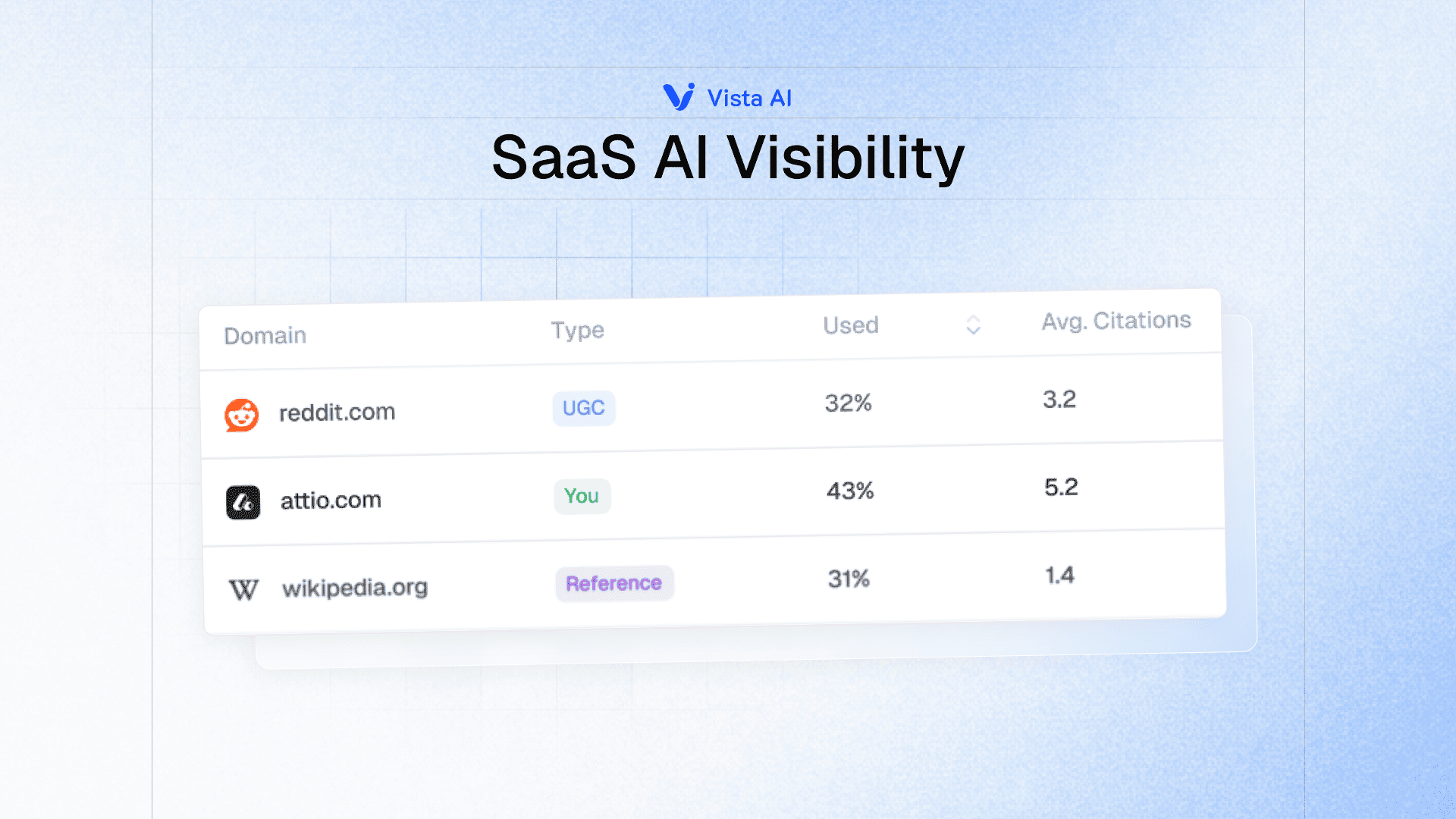
What sets it apart is that it's purpose-built for this problem rather than a bolted-on feature. It offers weekly citation frequency trends, a "top cited pages" dashboard, a breakdown of which platforms cite you most, content performance scoring, traffic attribution from AI sources, and white-label reporting for agencies.
The tradeoff is that VistaAI is a newer platform with a smaller customer base than incumbents like Semrush or Ahrefs, and its historical data is still limited since AI citation tracking is a new category. Pricing runs Starter at $49/Month. . It's the strongest fit for SaaS companies, publishers prioritizing AI search, agencies specializing in AI visibility, and content-driven businesses.
Verdict: ⭐⭐⭐⭐⭐ If AI search visibility is your primary focus, this is your tool.
2. Semrush — Best for Hybrid Needs
Semrush suits teams managing both traditional SEO and AI search rather than treating AI visibility as the main event. It covers comprehensive Google rank tracking plus a basic, still-emerging layer of LLM monitoring for ChatGPT citations, backed by a keyword database of over 200 million terms and rank tracking across 140+ countries.
Its strengths lie in traditional SEO: content templates based on top-ranking pages, competitive analysis, local SEO tools, white-label reporting, and API access make it a strong all-rounder for agencies handling many clients. The catch is that its AI search features aren't the primary focus yet, it carries a steeper learning curve, and it can get expensive for startups. Pricing starts at 120/month for the Protier(first5projects),120/month for the Protier(first5projects),240/month for Business (unlimited projects), and $450/month+ for Enterprise. It works best for agencies managing 50+ clients, enterprise teams with large keyword volumes, and brands that need both traditional SEO and AI monitoring in one place.
Verdict: ⭐⭐⭐⭐ Good if you need traditional SEO plus emerging AI features, but not optimized for AI visibility alone.
3. Ahrefs — Best for Backlink Analysis (Supplement with LLM Checks)
Ahrefs remains the go-to for teams focused on traditional SEO who are willing to track LLM citations manually on the side. Its Site Explorer, Keywords Explorer, and Content Gap tool make it excellent for backlink analysis, keyword research, and competitive content analysis, backed by strong rank tracking and API access.
Its main limitation for this use case is that it has no built-in LLM citation tracking, and it only shows rankings for keywords you're actively tracking. Pricing runs from 99/month(Lite)upto99/month(Lite)upto999/month+ (Enterprise), with Standard at 199/monthandAdvancedat199/monthandAdvancedat399/month in between. It's best suited to SEO specialists focused on traditional search, teams that want deep backlink data, content strategists researching competitors, and brands with smaller keyword sets in the 100–500 range.
Verdict: ⭐⭐⭐⭐ Best for traditional SEO — pair it with manual LLM tracking if AI visibility matters to you.
4. Google Search Console — Free, But Limited
Google Search Console is the natural starting point because it's free and comes straight from Google. It shows the queries driving traffic to your site, impressions and click-through rate, search appearance features like featured snippets, mobile usability, and indexing issues.
Its authority and price make it an easy first step, but it only shows keywords you're already ranking for, doesn't reveal exact positions, has no LLM data at all, and keeps just 90 days of history. It's best for solopreneurs just starting out, gathering a quick baseline, or validating a keyword strategy before investing in paid tools.
Verdict: ⭐⭐⭐ A useful supplement to paid tools, but not enough on its own.
5. DIY Manual Tracking (Spreadsheet)
For small teams working with a tight budget and 10–20 keywords, manual tracking is still viable: build a spreadsheet, check each keyword weekly across Google, ChatGPT, Claude, and Perplexity, log the ranking position and whether you appear in the LLM answer, and watch the trend month over month.
It costs nothing and is fully customizable, but it's slow (1–2 hours a week), doesn't scale past 20–30 keywords, is prone to manual error, and gives you no competitive data. It works well for solopreneurs, tiny teams, or as a proof of concept before committing to a paid tool.
Verdict: ⭐⭐ Fine for testing the waters, but it won't scale.
Comparison Table
| Tool | Google Tracking | LLM Tracking | Backlinks | Price | Best For |
|---|---|---|---|---|---|
| VistaAI | ✅ | ✅✅ (Best) | ❌ | $299–999/mo | AI search focus |
| Semrush | ✅✅ | ✅ (Basic) | ✅ | $120–450/mo | Hybrid needs |
| Ahrefs | ✅ | ❌ | ✅✅ (Best) | $99–999/mo | Traditional SEO |
| GSC | ✅ (Limited) | ❌ | ❌ | Free | Starting out |
| Manual | ✅ (Manual) | ✅ (Manual) | ❌ | Free | Proof of concept |
How to Choose
If AI search visibility is a primary goal, go with VistaAI. If you need traditional SEO and AI monitoring together, Semrush is the better fit. If deep backlink analysis matters most, pair Ahrefs with manual LLM checks. And if none of those apply yet, Google Search Console is a solid free starting point.
Implementation: Getting Started with VistaAI
Getting up and running takes about a month. In week one, sign up and add your domain, upload 50 target keywords (your Semrush export works well here), and set your tracking frequency to weekly. In week two, let the tool run and screenshot your baseline visibility score and citation frequency as your benchmark. In week three, check the dashboard regularly to see which keywords are earning citations and which competitors are dominating. By week four, identify your top 10 keywords by citation potential, update that content to optimize for LLM parsing, and re-check results two weeks later.
Real Results: Before & After Tool Implementation
A B2B SaaS company in the AI tools niche was previously tracking only Google rankings, with no visibility into LLM citations and no way to measure AI search ROI — optimization decisions were made on Google metrics alone.
After three months on VistaAI, its visibility score rose from 25 to 55 (a 120% increase), LLM citations jumped from 5 to 45 (an 800% increase), and AI search traffic grew from 0% to 3% of total traffic. Time spent optimizing actually dropped to 2 hours a week, since effort was now focused on high-impact keywords rather than guesswork. The shift came from optimizing for LLM citation potential rather than Google alone, restructuring the top 10 pages for clarity, adding schema markup to help LLMs parse content, and tracking real citation frequency instead of estimating it.