Your SEO efforts are scattered across dozens of metrics: rankings, traffic, backlinks, crawl errors. How visible are you in search? A search visibility score, one of several AI search visibility KPIs worth tracking answers exactly that.
A search visibility score (also called an SEO visibility score, website visibility score, or search engine visibility score) combines your rankings, traffic potential, and keyword coverage into a single metric, usually expressed as 0–100. It answers the question that matters most: are you more or less visible than you were last month? This guide explains what a search visibility score is, how it's calculated, why it matters, and how to use it to guide your strategy.
What Is a Search Visibility Score?
A visibility score is a composite metric that combines your keyword rankings, search volume, and ranking difficulty into a single 0-to-100 number representing your overall search visibility. The typical formula looks like this:
Visibility Score = (Sum of Traffic Potential from Ranked Keywords) / (Sum of Traffic Potential from All Target Keywords) × 100
In plain terms: say you have a list of 100 target keywords and you rank for 70 of them somewhere in positions 1 through 100. Your visibility score tells you what percentage of the potential traffic from those keywords you're actually capturing. For example, if your target keywords ("AI search visibility," "visibility score," "rank tracking tool," and others) represent 10,000 monthly searches in total, and your actual traffic from those keywords is 4,500 monthly visitors, your visibility score comes out to 45 out of 100, meaning you're capturing 45% of the available search opportunity.
Why Visibility Score Matters
The biggest advantage of a visibility score is that it replaces a scattered set of metrics with one number that summarizes everything. Without it, you're stuck reporting that twelve keywords improved while eight declined, that traffic rose 15% even as average ranking position fell 20%, and that you found 200 new keyword opportunities while losing 50 others, leaving the basic question of whether SEO is working genuinely unclear. With a visibility score, the same period reads simply as a move from 42 to 48, a 14% improvement, and the question of whether SEO is working has a direct answer: yes.
This single number also makes it far easier to track month-over-month progress and spot whether your SEO is actually moving the needle. A visibility score climbing steadily from 35 in month one, to 38 in month two, to 42 in month three, to 48 in month four tells a clean story of consistent progress that would otherwise take several disconnected charts to convey.
It's equally useful for competitive benchmarking. If your visibility score sits at 45 while competitors average 60, you know immediately that you're behind. Imagine your score is 45 against a Competitor A at 68, Competitor B at 62, and Competitor C at 55, putting the industry average at 58: the conclusion is immediate and unambiguous, you're below average and competitors are capturing more of the available visibility than you are.
Finally, a shared visibility score metric helps align teams around a single goal. Without it, marketing chases ranking improvements, sales wants raw traffic, and executives want revenue impact, with everyone effectively optimizing for something different. With a visibility score in place, the whole organization can rally around one measurable target, such as improving the score by 10% in a quarter, which is far easier to prioritize against than three competing metrics.
How Visibility Scores Are Calculated
Different tools calculate visibility scores slightly differently, but the general process follows five steps.
First, you select your target keywords, typically somewhere between 100 and 1,000 terms you want to rank for. You can track your visibility score automatically rather than pulling the numbers by hand — examples might include 'AI search visibility metrics' (1,000 monthly searches), 'rank tracking tool' (880 searches), or 'visibility score' (2,400 searches). Second, you calculate the traffic potential for each keyword by multiplying its monthly search volume by the expected click-through rate for your ranking position; if you rank third for "visibility score," with 2,400 monthly searches and roughly a 12% CTR at that position, the traffic potential works out to about 288 monthly visitors. Third, you sum the traffic potential across every target keyword to get your total potential traffic, which in this example might come to 10,000 monthly visitors. Fourth, you pull your actual traffic from these keywords using Google Search Console or another analytics tool, which in this case might show 4,500 monthly visitors. Fifth, you divide actual traffic by potential traffic and multiply by 100, giving you (4,500 / 10,000) × 100, or a visibility score of 45.
Visibility Score vs. Other Metrics
It helps to understand how a visibility score differs from the metrics you're probably already tracking. Rankings tell you your position for individual keywords, somewhere between 1 and 100, while a visibility score tells you the overall search opportunity you're capturing across all of them. If you improve ten rankings but only two of those keywords carry meaningful search volume, your rankings will look better while your visibility score barely moves, because the low-volume keywords simply don't contribute much to the total.
Traffic tells you how many visitors came to your site, while a visibility score tells you what percentage of available visitors you're actually capturing. Traffic rising 20% month-over-month sounds like good news, but if total search volume in your category grew 50% and competitors grew faster than you did, you're actually losing ground, capturing a smaller slice of a bigger pie. A visibility score would reveal that decline immediately, where a raw traffic number would mask it.
Keyword difficulty tells you how hard it is to rank for a single term, while a visibility score tells you how much of the overall market you're winning across every term you're tracking. Ranking first for one keyword with a difficulty of 90 feels like a win, but if you're ignoring fifty easier keywords sitting at a difficulty of 20, your overall visibility score will still be low, because there's a large amount of low-hanging fruit going uncaptured.
Google Visibility Score vs. Search Visibility Score
"Google visibility score" isn't an official metric Google publishes anywhere Google Search Console shows impressions, clicks and average position per query, but no single 0-to-100 number. What people usually mean by "Google visibility score" is the same search visibility score covered in this guide, calculated specifically from Google rankings rather than from all search surfaces. SEO tools including Semrush, Ahrefs and Searchmetrics each publish their own version of this metric under names like "Visibility Index" or "Organic Visibility," calculated the same general way: ranked keywords weighted by their traffic potential.
The distinction that matters going forward: a search visibility score built only from Google rankings misses how often your brand shows up in ChatGPT, Perplexity or Google AI Overviews, which don't use the same ranking system at all. See the AI visibility angle below.
Benchmarking Visibility Scores
What counts as a good visibility score depends heavily on your industry and target keywords, but the general ranges below are a useful starting point.
So what is a good SEO visibility score? As a rule of thumb, above 60 is good and above 80 is dominant but your real target depends on your industry, so use the ranges below as a starting point, not an one fixed benchmark.
| Score | Interpretation | Action |
|---|---|---|
| 0–20 | Very low visibility | Need comprehensive SEO strategy. Start with high-volume, low-difficulty keywords. |
| 21–40 | Below average | You're losing to competitors. Audit top 10 underperforming keywords. |
| 41–60 | Average | Competitive but not dominant. Focus on keywords where you rank 4-10 (lowest effort to improve). |
| 61–80 | Above average | Strong position. Defend top rankings. Build thought leadership for harder keywords. |
| 81–100 | Dominant | You're winning the market. Monitor for competitive threats. |
To put your own SEO visibility score in context, benchmark your score against competitors — pull their visibility scores (many tools expose competitor scores directly) and average them to establish an industry benchmark. If your score sits below that average, you have clear room to improve; if it sits above, you're already operating as a category leader.
How to Improve Your Visibility Score
There are three reliable strategies for moving the number, and they work on different timelines.
Targeting high-volume keywords delivers the fastest score improvements. Ranking for high-volume terms even at a modest position, say fifth through tenth for a keyword with 5,000 monthly searches, can deliver 200 to 400 visitors on its own. If your current keyword set sits mostly in the 500-to-1,000 monthly volume range and you add five to ten new targets above 2,000 monthly searches, you can typically expect a visibility score gain of 15 to 25 points.
Improving your existing ranking positions produces steadier, more sustainable gains. If you already rank for a large set of keywords, moving from position five to three, or ten to five, increases click-through rate by roughly 2% to 5% per position gained. Moving twenty keywords from the five-to-ten range into the three-to-four range typically yields a visibility score improvement of 8 to 12 points.
Targeting long-tail keywords builds visibility gradually but compounds well over time. Going after 100 long-tail terms with 200 to 500 monthly searches each, and ranking for 80 of them, can collectively capture 16,000 to 40,000 monthly visitors. Shifting from thirty highly competitive short-tail keywords toward 100 lower-competition long-tail variations commonly produces a visibility score gain of 20 to 30 points.
Real Example: Visibility Score Improvement Case Study
A B2B SaaS client in the AI search tools space started with a baseline visibility score of 32 out of 100 across 100 target keywords, ranking for 45 of them and pulling an estimated 3,200 monthly visitors from those terms.
Over six months, the strategy unfolded in phases: months one and two focused on targeting twenty new high-volume, low-difficulty keywords; months three and four focused on improving rankings for the fifteen most underperforming existing keywords; and months five and six focused on building out content for fifty long-tail variations.
By month six, the visibility score had risen to 58 out of 100, an 81% improvement, with ranked keywords climbing to 95 (up 111%) and estimated monthly traffic reaching 8,900, a 178% increase. The gains came from fifty newly ranked keywords, an average four-position improvement across fifteen existing keywords, better internal linking and content structure, and an increased publishing cadence of two articles per week.
AI Visibility Score: How It Differs
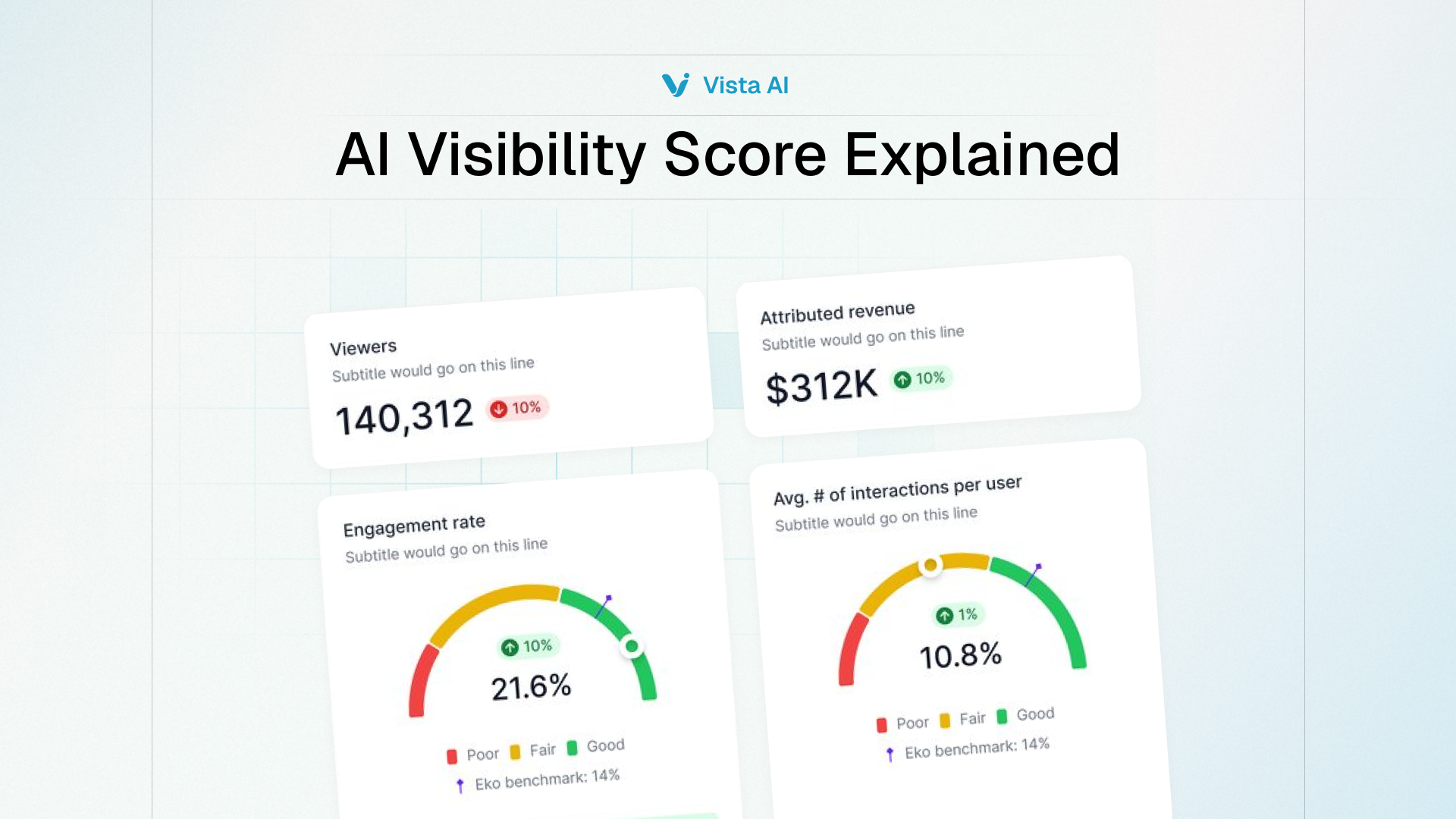
A traditional search visibility score is built entirely from Google rankings. An AI visibility score measures something adjacent but different: how often your brand is mentioned, recommended or cited in AI-generated answers from ChatGPT, Claude, Gemini and Perplexity, where there's no list of "positions 1 through 100" to measure against. Vista AI tracks both a combined visibility dashboard that shows your traditional search score next to your AI visibility score, so you can see whether you're losing ground in Google, in AI answers, or both.
Using Visibility Score in Your SEO Strategy
A monthly visibility score check-in effectively a lightweight SEO visibility report is straightforward to run. Start by pulling the current score and comparing it to last month, noting whether it's up, down, or flat. From there, analyze which keyword categories improved or declined and why, then identify quick wins, typically keywords already ranked four through ten that could move higher with light optimization, plus high-volume terms you don't currently rank for at all. Set a target for the next month (a realistic pace is two to five points of improvement), pick around five keywords to focus on, and assign clear ownership for the work, including what needs to change and by when. If your tracking tool supports it, glance at the daily visibility rank between monthly reviews to catch sudden drops early, but treat the monthly number as the one that drives decisions.
For quarterly business reviews, the same metric scales up cleanly into an executive presentation: show the visibility score trend from month one to month three, the estimated traffic currently being captured, the gap against your competitive benchmark, and a forecast of where the trend leads over the next twelve months if it continues at the current rate. Executives generally find "you went from 32 to 58 visibility" far more meaningful than "we ranked for 45 new keywords," because it ties directly to the business outcome they actually care about.
Visibility Score Tools
| Tool | Visibility Score Feature | Cost |
|---|---|---|
| VistaAI | Yes (traditional + AI) | $99/mo (7 day free trial) |
| Semrush | Yes (traditional only) | $139/mo |
| Ahrefs | Similar metric ("visibility") | $199/mo |
| Moz | Similar metric | $99/mo |
| Google Search Console | Free (estimated traffic) | Free |