ChatGPT getting ads made headlines, but it's the exception that proves a more interesting rule: the major AI platforms are not converging on one advertising model. They're making almost opposite bets. OpenAI leaned all the way in and hit a $1 billion annualized ad revenue run rate within 200 days. Google folded AI ads into infrastructure it already had. Microsoft quietly built some of the deepest in-conversation commerce tooling of any platform. And Perplexity tested ads, then walked away from them entirely, citing user trust.
If you're building a strategy for how your brand shows up across AI search, understanding why each company chose a different path matters as much as knowing what's live today, because it tells you which platforms are likely to stay ad-free and therefore purely citation-driven for the long run.
Perplexity: Tried Ads, Then Walked Away
Perplexity's advertising experiment is the most instructive data point in this whole landscape, precisely because it failed. Starting in 2024 and continuing into early 2026, Perplexity tested sponsored follow-up questions inside its "Related Questions" module a section that reportedly accounts for around 40% of all queries on the platform. Advertisers could sponsor a follow-up question; when a user clicked it, Perplexity's own model generated the answer, with sponsoring brands approving the underlying content in advance. The company's public position was that these AI-generated answers remained objective even though a brand had paid for the question's placement.
That position didn't hold up well with users, and by February 2026, Perplexity had pulled the ads and signaled it had no near-term plans to bring them back. A Perplexity executive put the reasoning plainly: "the challenge with ads is that a user would just start doubting everything … which is why we don't see it as a fruitful thing to focus on right now." Instead, the company is leaning into a subscription-first model, reportedly targeting $500 million in annualized subscription revenue and positioning itself explicitly as the ad-free alternative to ChatGPT and Google.
The lesson isn't that advertising is impossible in a conversational interface OpenAI's numbers say otherwise. It's that Perplexity's specific implementation (a sponsored question feeding into an AI-generated answer, versus a clearly separated sponsored card below an independently generated answer) blurred the line between paid and organic closely enough that it damaged trust in the product. That's a design lesson every AI platform experimenting with ads is now watching closely, and it's a strong signal that Perplexity itself is likely to remain a citation-only, ad-free environment for the foreseeable future.
Google: Ads Were Already There, Now They're Inside the Answer
Google didn't need to build new ad infrastructure it extended the infrastructure that already runs Search. As of April 2026, Google serves ads inside AI Overviews and AI Mode through existing tools advertisers already use: Performance Max, AI Max for Search, and broad-match-enabled Search campaigns. There's no separate "Gemini ads manager" to learn; if you already run Google Ads, your existing campaigns can become eligible for these placements with the right settings. Reporting from April 2026 found that roughly 25.5% of Google AI Mode responses now surface a sponsored placement a meaningfully higher ad density than what's been reported for ChatGPT's more limited placement.
There's an important distinction inside Google's own ecosystem, though: AI Overviews and AI Mode (both part of Google Search) carry ads, but the standalone Gemini app has not, and Google's own VP of Global Ads has publicly denied plans to change that directly contradicting reports from advertisers who say Google sales reps told them otherwise. That's an unresolved signal worth watching rather than treating as settled either way; the honest summary as of this writing is that Google's Search-integrated AI surfaces are ad-supported today, and the standalone Gemini assistant app's ad status is genuinely disputed even inside Google's own communications.
Microsoft Copilot: Quietly the Most Aggressive Bet
Microsoft has drawn less coverage than OpenAI or Google, but its Copilot ad integration may be the most structurally ambitious of the three. Eligible Microsoft Advertising campaigns can already appear directly within Copilot responses, and Microsoft has been building capabilities beyond a simple sponsored card: in-conversation commerce (letting a purchase happen inside the chat itself), Brand Agents, and Showroom Ads. That combination deep commerce integration plus an existing, mature ad platform to draw budget from gives Microsoft tooling that neither Google nor OpenAI currently matches in the same conversational surface.
The Landscape at a Glance
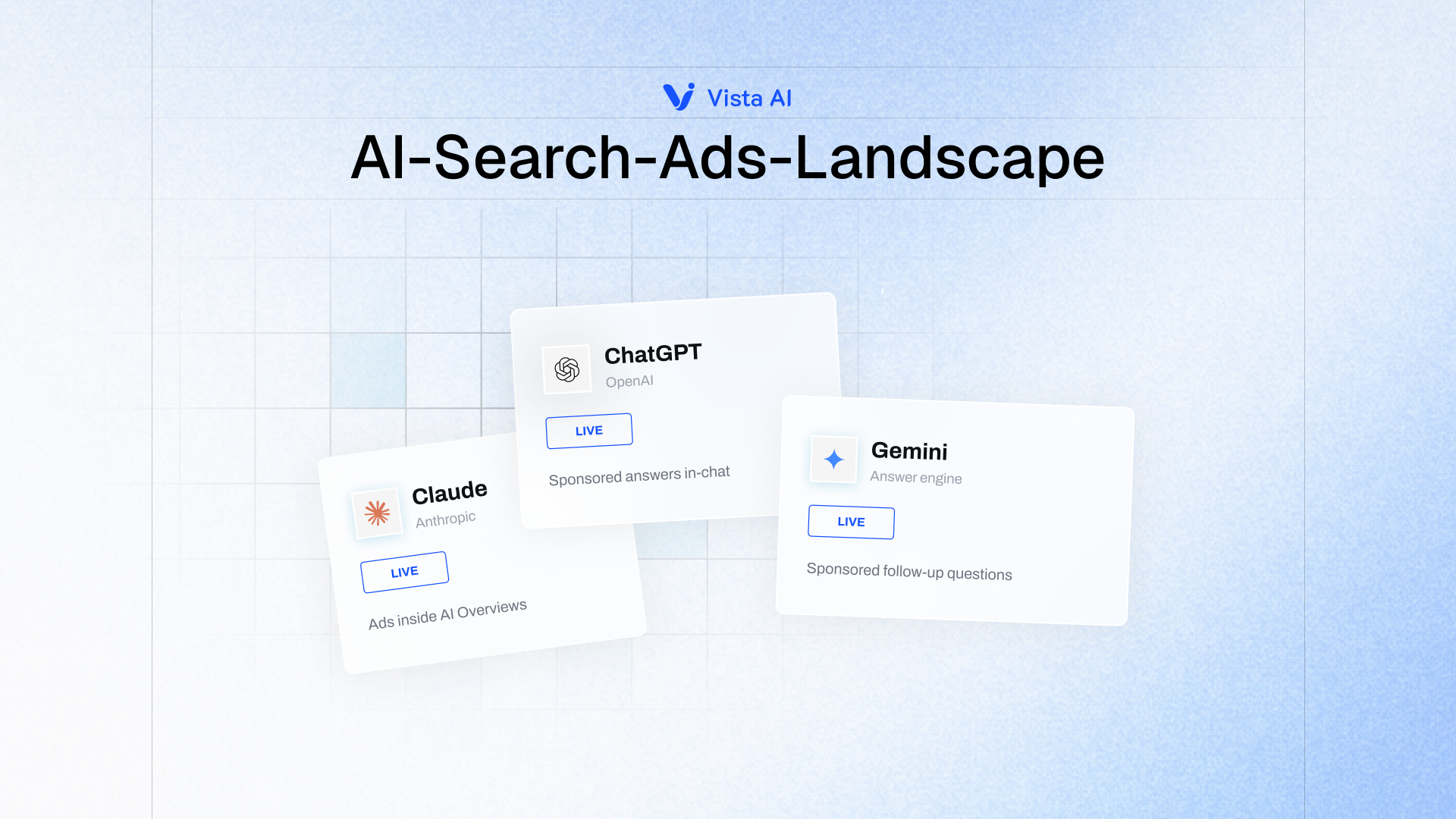
| Platform | Ads today? | Where they appear | How you buy | Reaches paying subscribers? |
|---|---|---|---|---|
| ChatGPT | Yes, since Feb 2026 | Sponsored card below the answer | Self-serve Ads Manager (CPC) | No — Plus/Pro/Business/Enterprise/Education stay ad-free |
| Perplexity | No — tested, then discontinued | N/A (discontinued) | N/A | N/A |
| Google (AI Overviews / AI Mode) | Yes | Inside the AI answer block in Search | Existing Google Ads (Performance Max, AI Max, broad-match Search) | Ads run in Search regardless of a Google One subscription |
| Google Gemini app | Disputed | N/A currently | N/A | N/A |
| Microsoft Copilot | Yes | In-response placements, plus in-chat commerce | Microsoft Advertising | Varies by Copilot tier and integration |
| Claude (Anthropic) | No | N/A | N/A | N/A |
What the Split Strategy Actually Tells You
Line the platforms up and a pattern emerges that's easy to miss if you only track ChatGPT. The platforms leaning hardest into advertising OpenAI, Google, Microsoft are also the platforms with either an existing ad business to protect and extend (Google, Microsoft) or the most direct need to fund massive compute costs for a free consumer product at OpenAI's scale. The platforms staying out Perplexity, at least for now, and Claude, which has never introduced ads are the ones explicitly competing on being the more trustworthy, less commercially compromised option. Perplexity didn't just fail to monetize ads; it made an active strategic choice to compete on trust instead, and it's using "we don't have ads" as a subscription pitch.
That's not a minor detail for your strategy. It means the AI search landscape isn't converging toward "ads everywhere, citations matter less." It's bifurcating into ad-supported surfaces where you'll increasingly need both a paid and organic strategy, and trust-positioned surfaces where organic citation quality will likely remain the only lever that exists, indefinitely. Planning your AI visibility budget as if every platform will eventually look like Google Search is a bad bet given what's actually happened in the last twelve months.
What This Means for a Multi-Platform AI Visibility Strategy
You cannot buy a consistent advertising presence across AI search the way you can buy one across Google and Meta today. The buying mechanics, eligibility rules, and even the basic existence of an ad product differ platform by platform, and at least one major platform has already reversed course once. Organic citation quality is the only lever that works identically everywhere ChatGPT, Perplexity, Claude, Gemini and Copilot alike because it doesn't depend on any single company's monetization roadmap holding steady.
That argues for treating your AEO investment as platform-agnostic infrastructure and any AI ad spend as platform-specific and provisional. Track how you actually show up across all five surfaces with something like Vista's AI Rank Tracker, which monitors citations across ChatGPT, Claude, Perplexity, Gemini and Copilot rather than betting your visibility measurement on any one platform's ad dashboard. For the deeper mechanics of how paid and organic interact specifically on ChatGPT, see ChatGPT Ads Are Here: What They Mean for Your Brand's AI Visibility Strategy, and if you're weighing an actual ad budget, our ChatGPT ads cost breakdown has current pricing.
What Perplexity's Reversal Should Make You Cautious About
It's worth dwelling on the Perplexity story a moment longer, because it's easy to read it as "Perplexity failed at ads" when the more useful reading is "the market punished a specific design choice." Sponsoring a follow-up question that then triggers an AI-generated answer blurs paid and organic in a way a clearly separated sponsored card doesn't. That distinction separation versus blending is exactly the line OpenAI has tried to hold with ChatGPT's "answer independence" principle, and it's the same line Google is walking by keeping ads inside a visually distinct block within AI Overviews rather than inside the generated answer text itself.
The practical takeaway for brands isn't just "know which platforms have ads." It's "watch whether each platform is keeping paid and organic visibly separate, and be skeptical of any platform or any brand-side interpretation of a platform that starts to blur them." If a platform ever lets sponsorship shape the actual generated answer rather than sitting next to it, that's a trust signal worth watching closely, both for how users will react and for how sustainable that ad product is likely to be. Perplexity already ran that experiment for the whole industry and published the result.