Here are two AI answers that would both count as "mentioned":
"[Brand] is a strong choice for growing teams. It's known for fast setup and responsive support."
"Some users consider [Brand], though reviewers note that pricing has increased and support can be slow. You may want to consider alternatives."
A visibility tracker that only counts mentions scores these the same. A buyer reading them comes away with opposite conclusions.
As more product research happens inside AI assistants, how the AI describes you matters as much as whether it names you. This guide covers how to measure brand sentiment in AI answers, what drives it, and how to fix framing that works against you.
Why AI Sentiment Is Different From Social Sentiment
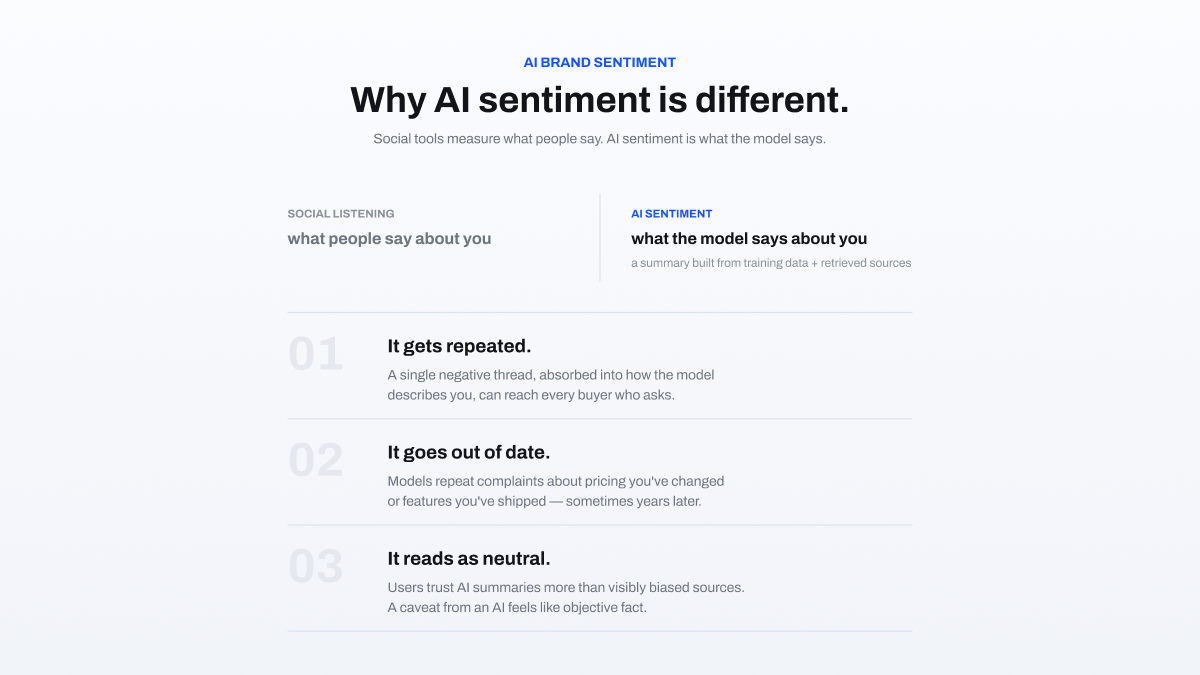
Social listening tools measure what people say about you. AI sentiment measures what the model says about you. That's a summary built from its training data and the sources it retrieves.
That brings three specific risks:
- It gets repeated. A single negative Reddit thread is one opinion. If a model has absorbed it into how it describes you, it can reach every buyer who asks.
- It goes out of date. Models can repeat complaints about pricing you've changed, features you've shipped, or problems you've fixed, sometimes years after the fact.
- It reads as neutral. Users tend to trust AI summaries more than visibly biased sources. A caveat from an AI feels like objective fact.
The Four Layers of AI Sentiment
Positive/negative/neutral is too blunt to act on. Look at four layers instead.
1. Recommendation strength
How strongly does the AI endorse you?
- Primary recommendation: "The best option for X is [Brand]."
- Shortlisted: "Good options include [Brand], A, and B."
- Conditional: "[Brand] could work if you need X."
- Hedged/discouraged: "Some consider [Brand], but..."
2. Hedging and caveat language
Watch for qualifiers attached to your brand that aren't attached to competitors: "although," "however," "some users report," "can be expensive," "steeper learning curve," "may not be suitable for." When a model consistently hedges about one brand and not others, that's a sentiment signal even if no sentence is openly negative.
3. Attribute associations
Which qualities does the AI tie to you? Note the adjectives and attributes it uses: "affordable," "enterprise-grade," "beginner-friendly," "outdated," "complex." Then compare them with how you position yourself. A gap between the two is a positioning problem.
4. Factual accuracy
Does the AI get the facts right? Check pricing, features, integrations, company size, leadership, and availability. An inaccurate statement isn't "negative sentiment," but it often causes lost deals.
How to Measure It
Step 1: Use prompts that invite evaluation
Sentiment shows up most in prompts where the AI has to judge:
- "Is [Brand] worth it?"
- "What are the pros and cons of [Brand]?"
- "[Brand] vs [Competitor]: which should I choose?"
- "What do users complain about with [Brand]?"
- "Best [category] for [use case]" (to see how you're framed next to others)
Step 2: Sample across platforms and runs
Framing varies by platform and by run. Perplexity often draws on recent reviews and forums. ChatGPT without search relies more on training data, which can be older. Run each prompt several times on each platform.
Step 3: Score each answer
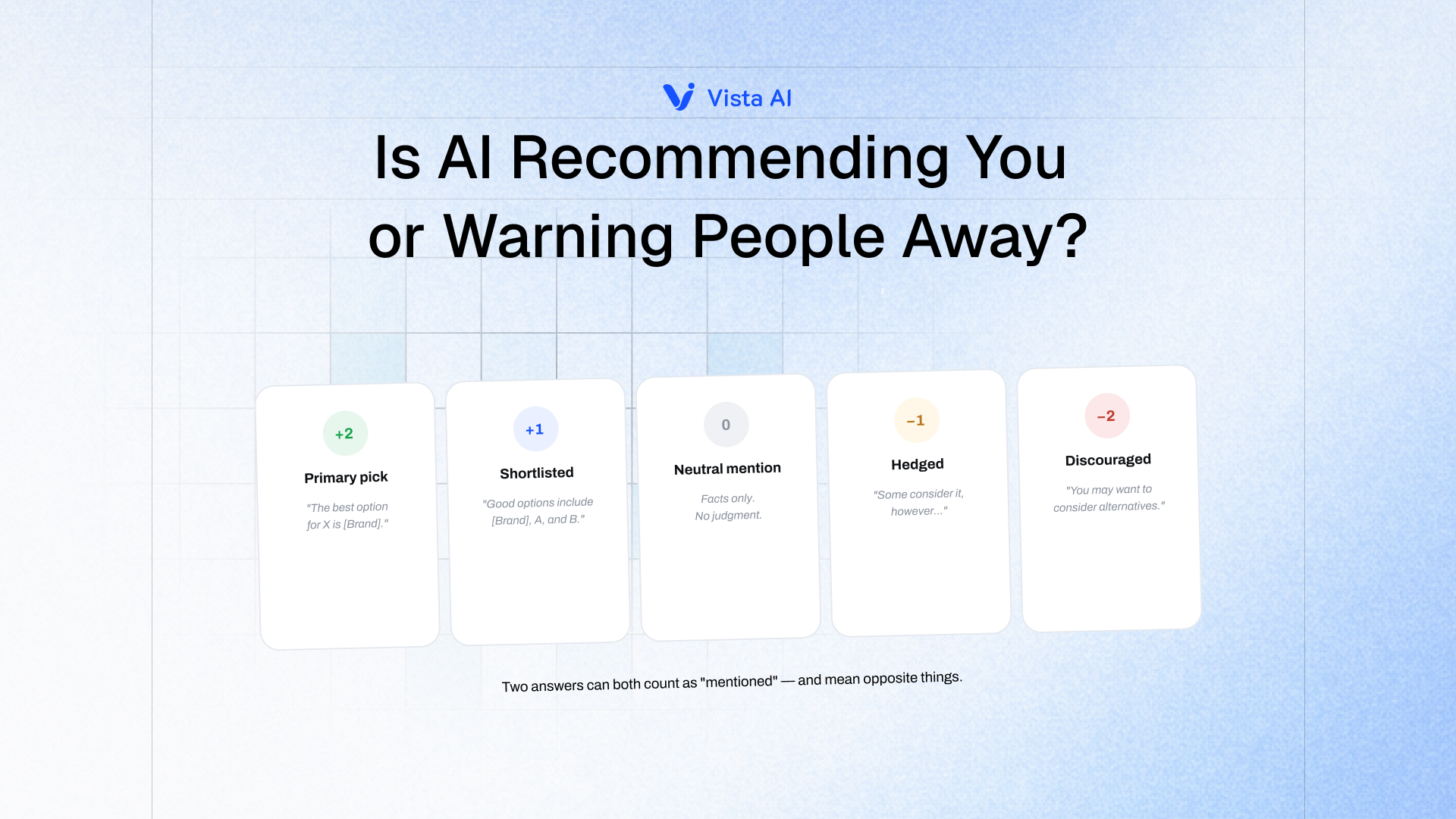
A simple scoring rubric:
| Score | Meaning |
|---|---|
| +2 | Primary recommendation, positive attributes |
| +1 | Shortlisted, neutral-positive framing |
| 0 | Mentioned neutrally / factual only |
| −1 | Mentioned with caveats or hedging |
| −2 | Discouraged, or negative claims dominate |
Also flag every factual error separately.
Step 4: Compare against competitors
Score your competitors on the same prompts. An average of +0.4 means little alone. It means a lot if your main competitor averages +1.3.
Step 5: Trace the sources
For negative or inaccurate answers, look at the cited sources. You'll usually find the cause there: an old review, a critical forum thread, an outdated comparison article, or a competitor's "vs" page.
What Drives Negative AI Framing (and How to Fix It)
Outdated third-party content.
Fix: Ask review platforms and comparison publishers to update their information. Publish a clearly dated "what's new" or changelog page. Make sure current pricing and features are stated plainly on your site.
Unanswered complaints in public forums.
Fix: Respond publicly and constructively where it makes sense, especially on Reddit, community forums, and review sites. Resolved threads are summarized very differently from unresolved ones.
Competitor comparison pages.
Fix: Publish your own fair, specific comparison pages. Models often draw on both sides of a comparison, so if only the competitor has written one, only their version gets used.
Vague positioning.
Fix: If the AI calls you "complex" when you see yourself as "powerful," state your positioning plainly, with proof. For example: "Most teams are live in under a day," backed by onboarding data or case studies.
Missing factual sources.
Fix: Keep authoritative, crawlable pages for pricing, features, security/compliance, and company facts. Add organization and product schema. When a model searches, it should find your current facts first.
Thin positive coverage.
Fix: Encourage reviews from satisfied customers, and publish case studies with named customers and measurable outcomes. Positive evidence has to exist before an AI can summarize it.
How Often to Monitor
- Weekly for evaluation prompts in your core category
- Right after pricing changes, launches, incidents, or press coverage
- After major model updates, which can change framing even when your content hasn't changed
Monitoring Sentiment With Vista AI
The Vista AI Brand Visibility Dashboard tracks how your brand is framed across ChatGPT, Perplexity, Gemini, Claude, Copilot, and Google AI Overviews, alongside your mention rate and share of voice. Combined with AI Citation Tracking, you can trace a negative answer back to the source that caused it and confirm when your fix takes effect.