SEO teams have tracked rankings the same way for two decades: choose keywords, check the position each day, chart the line. So when leadership asks "where do we rank in ChatGPT?", the natural move is to reuse the same model.
It mostly doesn't work. "Rank" in an AI answer is a different thing to measure, and if you track it like a Google position you'll get numbers that look precise and mislead you.
Here are the seven differences that matter, and what to measure instead.
Difference 1: Keywords vs. Prompts
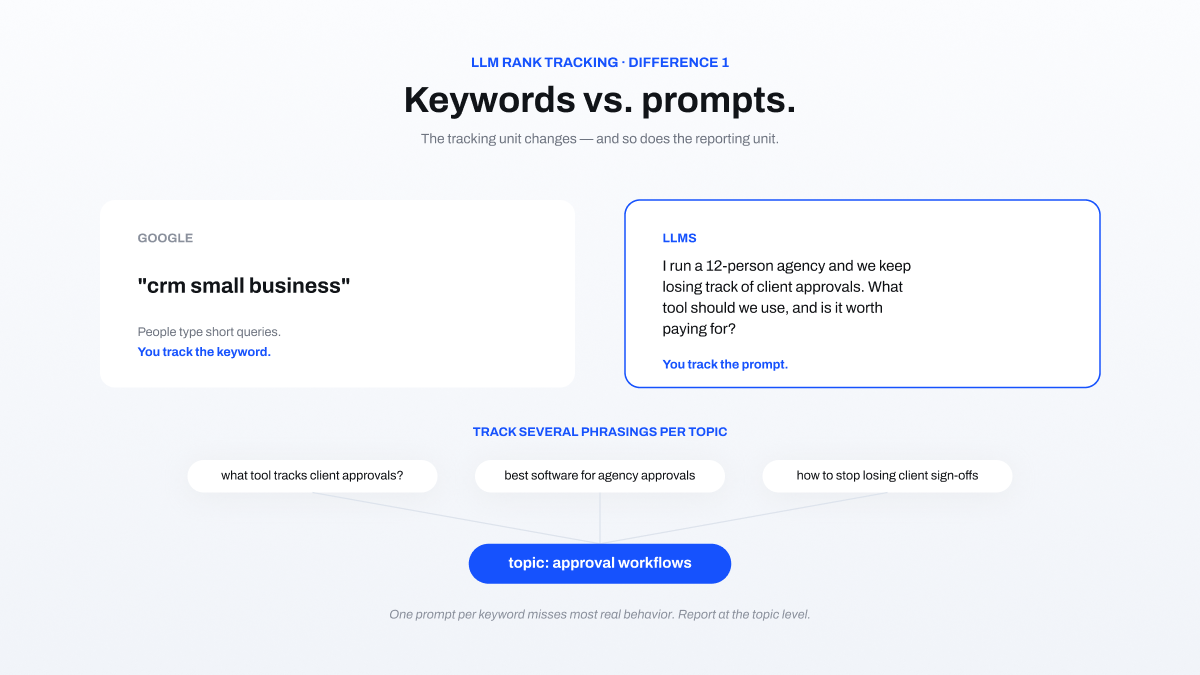
Google: People type short queries ("crm small business"). You track the keyword.
LLMs: People ask full, conversational questions with context: "I run a 12-person agency and we keep losing track of client approvals. What tool should we use, and is it worth paying for?"
What changes: Your tracking unit becomes the prompt, and the useful unit for reporting is the topic, a cluster of prompts that share intent. Tracking one prompt per keyword misses most real behavior. Track several phrasings per topic and report at the topic level.
Difference 2: Fixed Results vs. Varying Answers
Google: For a given query, location, and device, the top 10 is fairly stable from hour to hour. Checking once a day is enough.
LLMs: The same prompt can produce a different answer each time it's run. The brands named, their order, and the sources cited all vary.
What changes: A single check says almost nothing. LLM rank tracking is sampling: run each prompt several times and report frequencies, such as "named in 7 of 10 runs," instead of one position. If a tool reports "you rank #2 in ChatGPT" from a single run, ask how many runs that number is based on.
Difference 3: Position vs. Presence
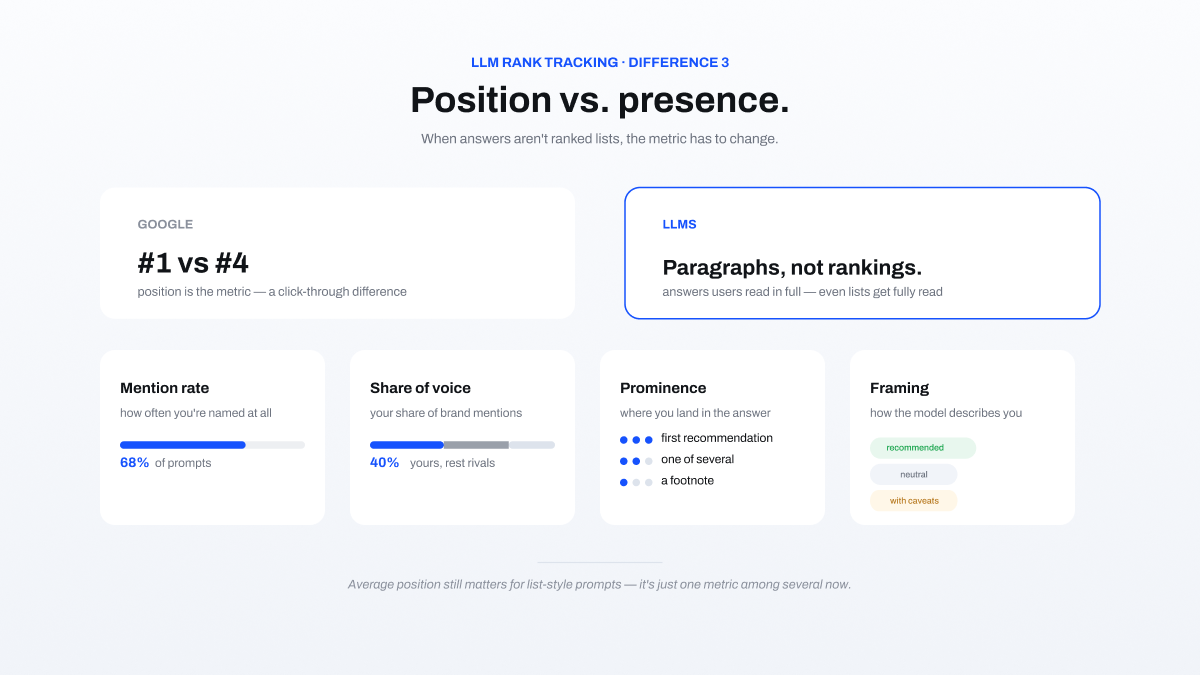
Google: Position 1 vs. position 4 is a well-understood click-through difference. Position is the metric.
LLMs: Many answers aren't ranked lists. They're paragraphs, recommendations, or step-by-step explanations. Even when there is a list, the user often reads all of it.
What changes: The primary metrics move from position to presence and prominence:
- Mention rate: how often you're named at all
- Share of voice: your share of all brand mentions against competitors
- Prominence: first recommendation, one of several, or a footnote
- Framing: recommended, neutral, or mentioned with caveats
Average position still has value for list-style prompts, but it becomes one metric among several.
Difference 4: One Engine vs. Many
Google: For most markets, rank tracking means Google (plus Bing if you're thorough).
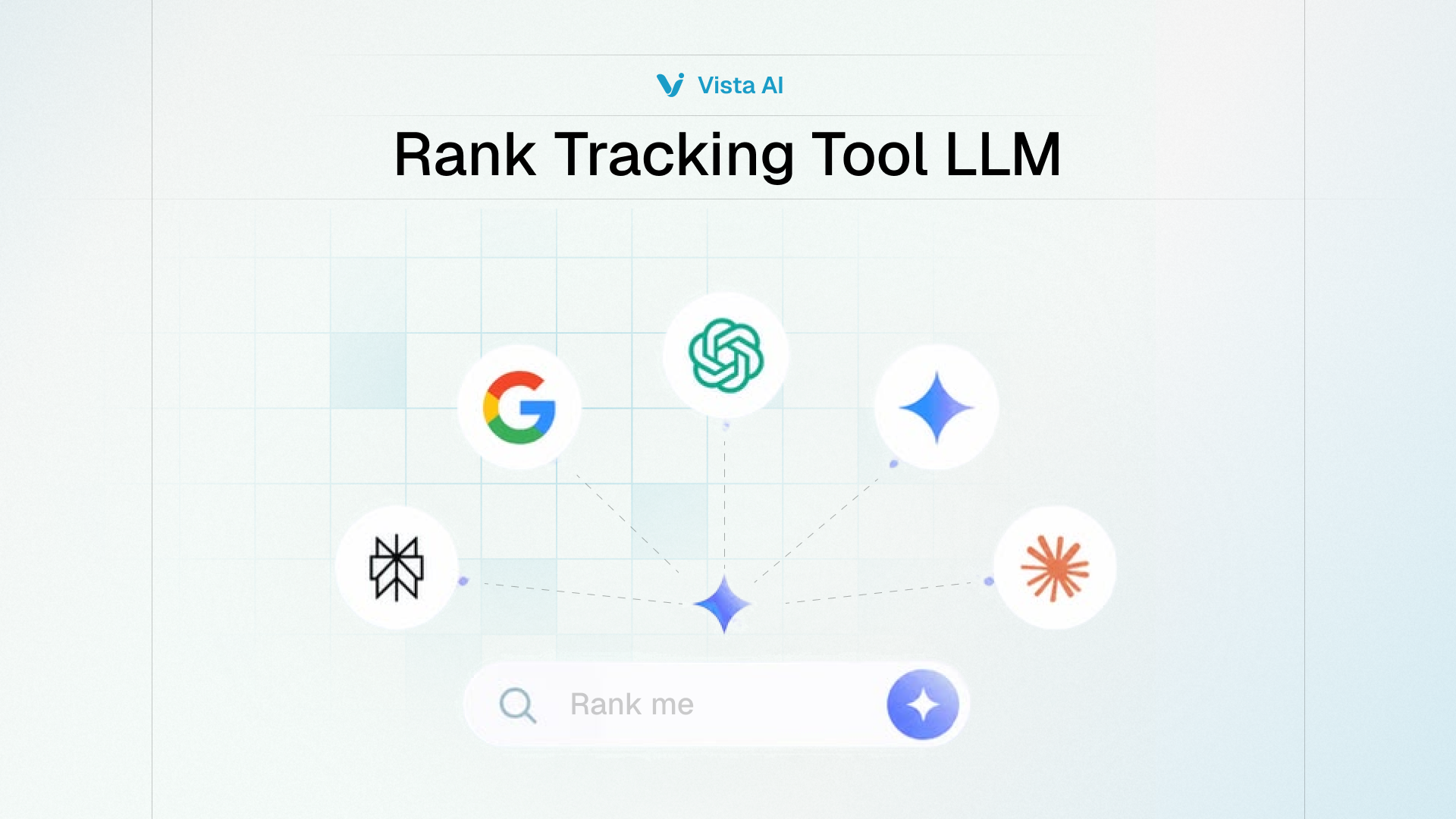
LLMs: ChatGPT, Perplexity, Gemini, Claude, Copilot, DeepSeek, Google AI Overviews, and Google AI Mode each work differently. Some search the live web on every query, some only sometimes, and some lean heavily on training data. Visibility on one platform tells you little about another.
What changes: Track per platform and weight the platforms by where your audience is. A B2B developer tool might weight Claude and ChatGPT heavily. A consumer brand might prioritize Google AI Overviews and ChatGPT.
Difference 5: Location and Personalization Work Differently
Google: Location and device are the main variables, and rank trackers handle them.
LLMs: Location still matters, especially for local and regional prompts. But memory, custom instructions, conversation history, logged-in state, and the model version selected can all shift answers too.
What changes: Good LLM tracking runs from clean, standardized sessions: no memory, no history, a consistent location. Results then reflect what a typical new user sees, not what you see on your own account.
Difference 6: Ranking Pages vs. Being Named and Being Cited
Google: One result = one URL. Your rank is a page's rank.
LLMs: An answer can name your brand without linking you, or cite your page without naming you. These are separate outcomes. (See AI mentions vs. AI citations.)
What changes: Track two layers:
- Brand layer: Are you mentioned, where, and how?
- Source layer: Which URLs are cited, which of yours, and which competitor and third-party domains?
The source layer is where you find out why you rank where you do.
Difference 7: Algorithm Updates vs. Model Updates
Google: Core updates happen a few times a year and are announced. You can chart before and after.
LLMs: Model versions, retrieval systems, and default settings change often, sometimes without notice. A new default model in ChatGPT can reshuffle a category overnight.
What changes: Keep continuous history and annotate it with known model releases. When visibility moves, your first question is "did we change something, or did the model?"
What Stays the Same
Not everything changes. Several SEO fundamentals carry straight over:
- Pick queries based on business value, not vanity. Track the prompts that lead to revenue.
- Benchmark against competitors. An absolute number means little without context.
- Group into topics. Keyword clusters become prompt clusters.
- Trends beat snapshots. Direction over time is the real signal.
- Rankings follow content and authority. Pages that answer clearly, from sources the web trusts, win in both systems. Strong Google rankings also tend to help Google AI Overviews, which draw heavily on pages that already rank.
A Practical LLM Tracking Setup
- Choose 5–10 topics tied to revenue.
- Write 5–8 prompt variations per topic, mixing short and conversational phrasings.
- Select platforms based on where your audience asks questions.
- Run each prompt several times per cycle in clean sessions.
- Record: brand named (y/n), prominence, framing, every cited URL, and competitors named.
- Report at the topic level: mention rate, share of voice, citation share, and change over time.
- Review monthly, with model release dates marked on the chart.
Translating for Your SEO Dashboard
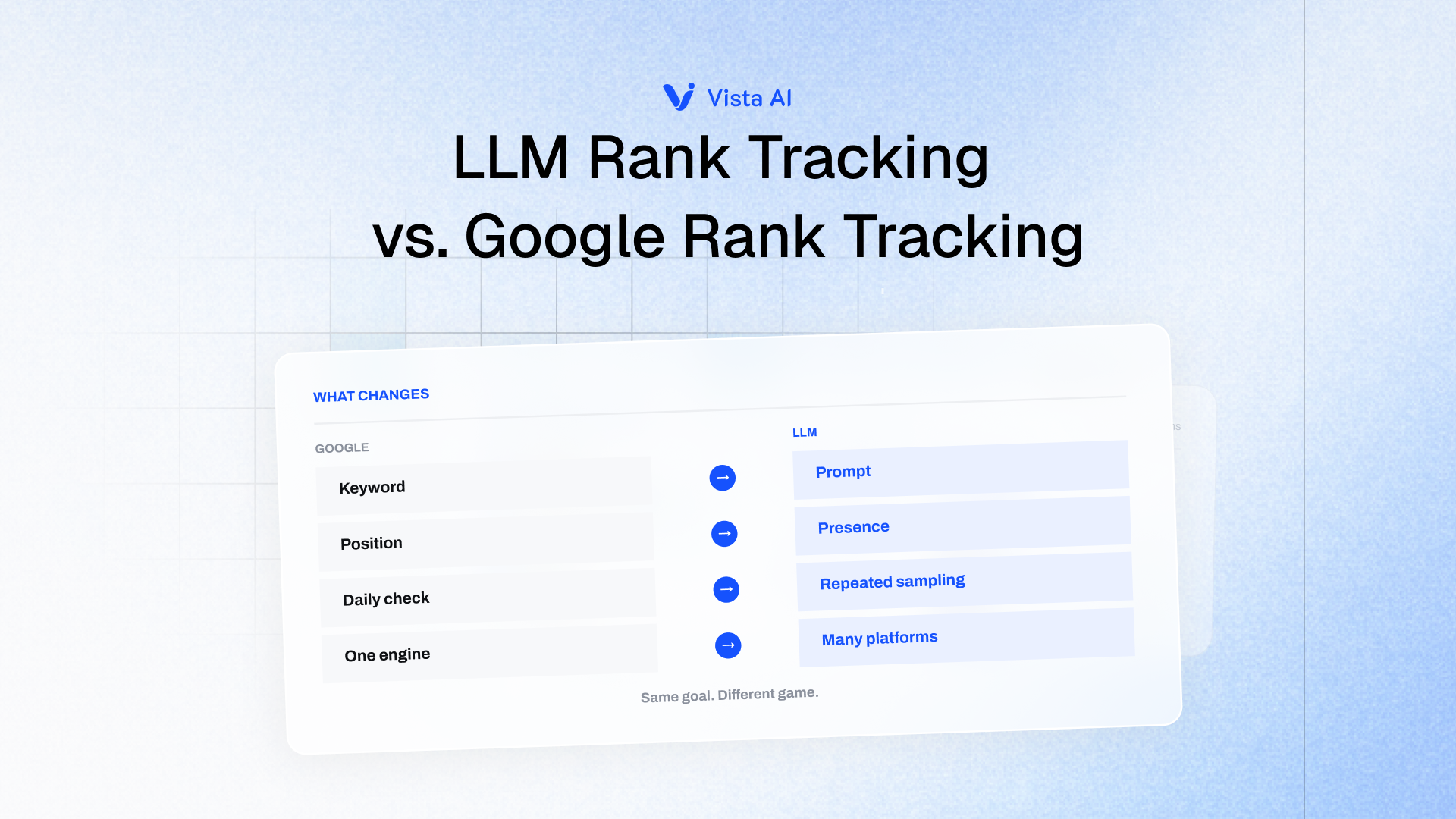
| Google metric | LLM equivalent |
|---|---|
| Keyword | Prompt (grouped into topics) |
| Position | Mention rate + prominence |
| Visibility index | Share of voice |
| Ranking URL | Cited URL(s) |
| SERP features | Platform (ChatGPT, Perplexity, AI Overviews…) |
| Daily rank check | Repeated sampling per cycle |
| Algorithm update | Model / retrieval update |
Where Vista AI Fits
Vista AI's Rank Tracker is built around these differences. It tracks prompts grouped into topics, runs them repeatedly across ChatGPT, Perplexity, Gemini, Claude, Copilot, DeepSeek, and Google AI Overviews, and reports mention rate, share of voice, and cited sources over time instead of a single position number.
Track where you actually rank in AI answers. Start for free with Vista AI