
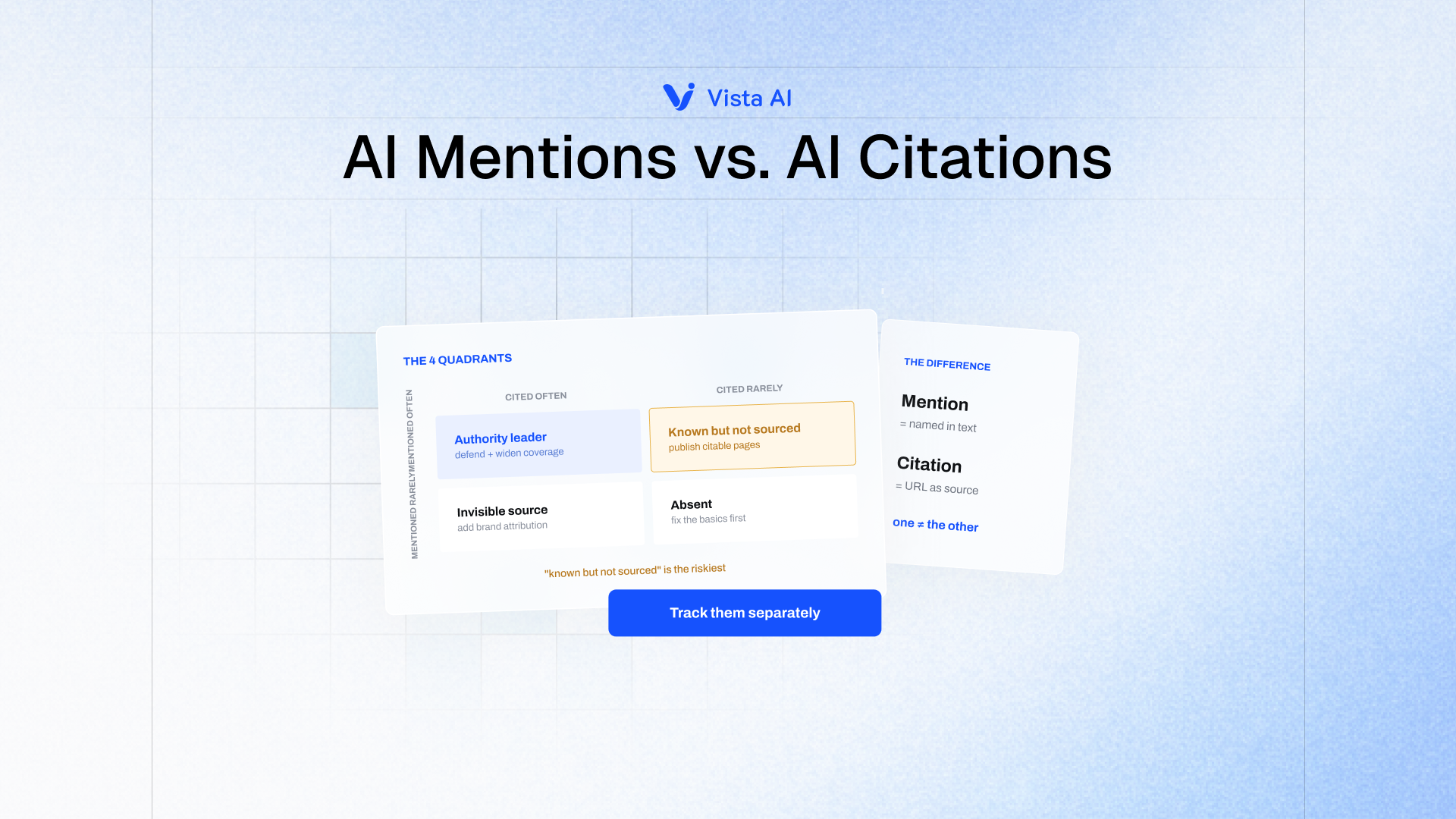
Ask ChatGPT "what's the best project management tool for a remote agency?" and you'll usually get two kinds of brand exposure in one answer.
The first is a mention: your brand's name appears in the text of the answer. "Asana and Monday.com are popular choices for remote teams..."
The second is a citation: your website is linked as a source the model used to build the answer. It shows up as a numbered footnote, a source card, or a link under the response.
These sound like the same thing, and plenty of teams report them as one number. They aren't. A brand can be mentioned constantly and never cited. A website can be cited constantly while the brand behind it is never named. If you mix the two together, you can't tell which problem you have, and so you can't tell which fix to apply.
This guide explains the difference, the metrics built on each, and how to use both to run your AI visibility program.
The Short Definitions
AI mention: Your brand, product, or person is named in the generated text of an AI answer. A mention doesn't need a link. It reflects what the model "knows" or retrieved about you and whether it chose to bring you up.
AI citation: A URL on your domain is attached to the answer as a source. A citation doesn't need your brand to be named in the text. It reflects whether the model's retrieval step picked your page as evidence.
Citation share: The percentage of all citations across a set of prompts that point to your domain, compared with every other domain cited. If 200 citations appear across your tracked prompts and 18 of them link to your site, your citation share is 9%.
Mention share (share of voice): The percentage of tracked answers that name your brand, usually set against named competitors.
Why the Two Diverge
Mentions and citations come from different parts of how answer engines work.
Mentions come from what the model knows and what it retrieved
When a model names a brand, it's drawing on two sources: its training data (what the open web said about you before the model's cutoff) and whatever live content it retrieved for this query. A brand with years of reviews, forum threads, comparison articles, and press coverage gets named often, even when the model doesn't link to the brand's own site.
That's why large, established brands get a lot of mentions with relatively few citations to their own domains. The model already "knows" them.
Citations come from retrieval
When an answer engine searches the web to ground its answer (Perplexity does this on almost every query, and ChatGPT search, Gemini, Copilot, and Google AI Overviews do it on many), it picks specific pages as evidence. Those pages get cited.
Retrieval prefers pages that answer the question directly, are easy to extract a passage from, and are crawlable and fresh. A well-structured guide from a small publisher can be cited ahead of a big brand's homepage. That's why educational sites, review sites, and niche blogs often collect lots of citations while being named rarely, or never, in the answer text.
The Four Visibility Situations
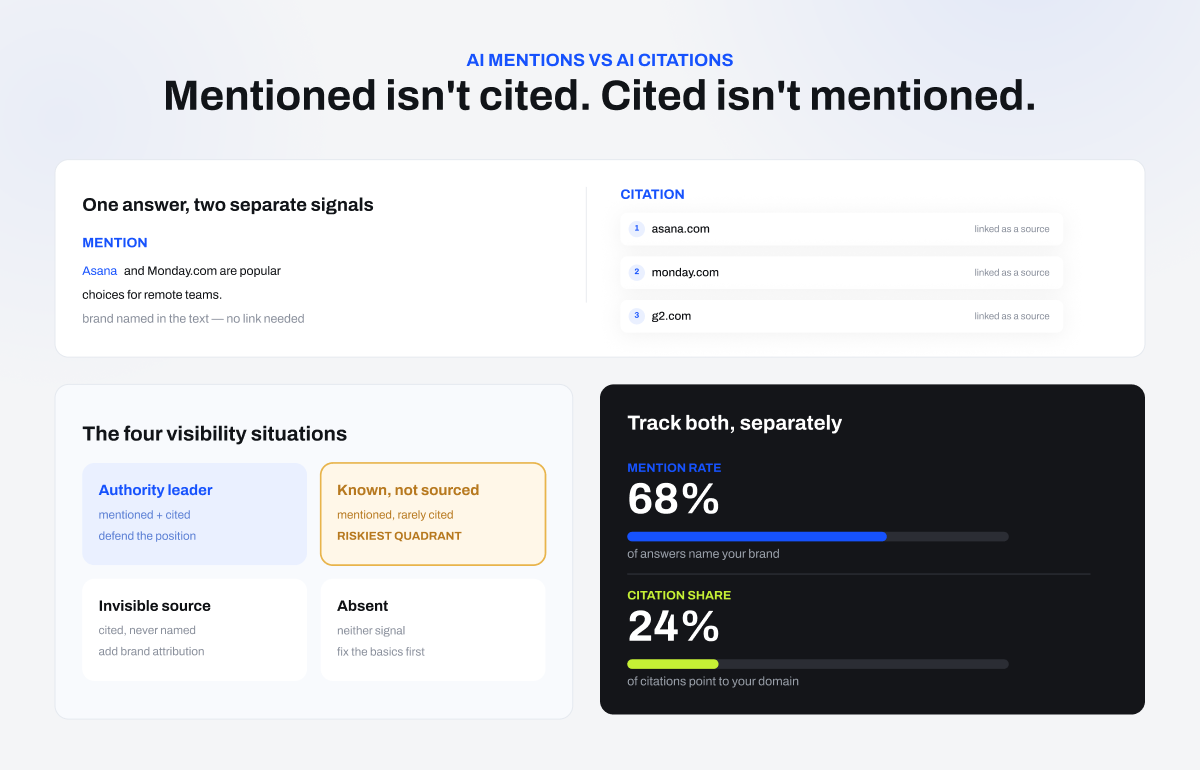
Plotting the two signals against each other gives four situations, and each one calls for a different response.
| Cited often | Cited rarely | |
|---|---|---|
| Mentioned often | Authority leader. The model knows you and uses your content as evidence. Defend the position and widen prompt coverage. | Known but not sourced. The model talks about you, but other sites shape the story. Publish citable, first-party pages so your own words are used. |
| Mentioned rarely | Invisible source. Your content is used, but your brand gets no credit. Add clear brand attribution, original data, and named frameworks to the content. | Absent. Neither signal is there. Start with the basics: crawlability, entity clarity, and third-party coverage. |
"Known but not sourced" is the riskiest quadrant
When a model mentions you but cites G2 reviews, a Reddit thread, and a competitor's comparison page, those third parties are writing your description. If any of them are out of date or unflattering, the AI repeats them. Teams in this quadrant should audit which URLs are actually cited next to their brand name, then publish first-party pages that answer the same questions more completely: pricing explainers, comparison pages, implementation guides.
"Invisible source" is the most common quadrant for content-led companies
B2B companies with strong blogs often land here. Perplexity cites their guide on "how to calculate churn rate," but the answer never says "according to [Brand]." The content is doing the work and the brand gets none of the credit.
Fixes that tend to help:
- Original data with your name on it. "A 2026 study of 4,000 SaaS companies by [Brand] found..." gives the model a reason to attribute.
- Named frameworks and methods. A model is more likely to name a source when it repeats a concept that belongs to that source.
- Clear author and organization signals. Bylines, an organization schema, and an "About" page that defines the entity.
Which Metric Matters More?
It depends on what the AI answer is for.
Mentions matter more for recommendation prompts. For "best CRM for small business," "top alternatives to X," or "which tool should I use for Y," the user acts on the names in the text. Most never click a source. Being named, and named favorably, is the outcome.
Citations matter more for informational and research prompts. For "how does X work," "what is the average cost of Y," or "how to do Z," users who want to go deeper click the sources. Citations are also the only AI signal that can send measurable referral traffic to your site.
For most brands, track both and report them separately. A single blended "AI visibility" number hides which lever to pull.
How to Measure Each One
Measuring mentions
- Build a prompt set that reflects real buyer questions: category ("best X for Y"), comparison ("X vs Y"), problem ("how do I fix Z"), and branded ("is [Brand] good for...").
- Run each prompt across platforms. ChatGPT, Perplexity, Gemini, Google AI Overviews/AI Mode, Copilot, and Claude give noticeably different answers to the same question.
- Record presence, position, and framing. Was the brand named? First in the list or fifth? Recommended, merely listed, or flagged with a caveat?
- Repeat on a schedule. AI answers vary between runs. One check is an anecdote. Weekly sampling gives you a trend.
Key mention metrics: mention rate (% of prompts where you're named), share of voice against competitors, average list position, and sentiment of the framing.
Measuring citations
- Use the same prompt set.
- Capture every cited URL in each answer, not just whether your domain appeared.
- Group citations by domain to calculate citation share, and by URL to see which of your pages earn citations.
- Look at the competing sources. The domains cited instead of you show you where to earn coverage or what to out-publish.
Key citation metrics: citation rate (% of answers citing your domain), citation share, top-cited URLs, and the list of competitor and third-party domains cited for your target prompts.
Linking the two
The most useful view lines the two up per prompt: for this prompt, were we mentioned, were we cited, and who was cited instead? That one view tells you whether you need content work (no citation), reputation work (cited but framed poorly), or entity work (nothing at all).
Common Mistakes When Reporting These Metrics
Counting a citation as a mention. If your blog post is cited but the text recommends three competitors, that isn't a win for the recommendation prompt. It may even be a loss: your content helped build an answer that sent buyers to someone else.
Ignoring third-party citations about you. A citation of a review site that discusses your brand still shapes your AI visibility, even though it isn't your domain. Track the domains that are cited when your brand is mentioned.
Reporting a single run. AI responses vary. Report rates over a sample (for example, "named in 34% of 50 weekly runs"), not a yes/no from one check.
Tracking only ChatGPT. Citation behavior differs a lot between platforms. Perplexity cites heavily and visibly. ChatGPT cites only when it searches. Google AI Overviews draw strongly on pages that already rank. A brand can be a strong citation source on one platform and absent on another.
How Vista AI Tracks Both
Vista AI's AI Citation Tracking records every source URL cited for your tracked prompts across ChatGPT, Perplexity, Gemini, Google AI Overviews, and more. The Brand Visibility Dashboard reports mention rate and share of voice side by side, so you can see at a glance which of the four quadrants you're in for each topic.
See how AI talks about your brand. Track mentions, citations, and citation share across ChatGPT, Perplexity, Gemini, and more. Start for free