Introduction
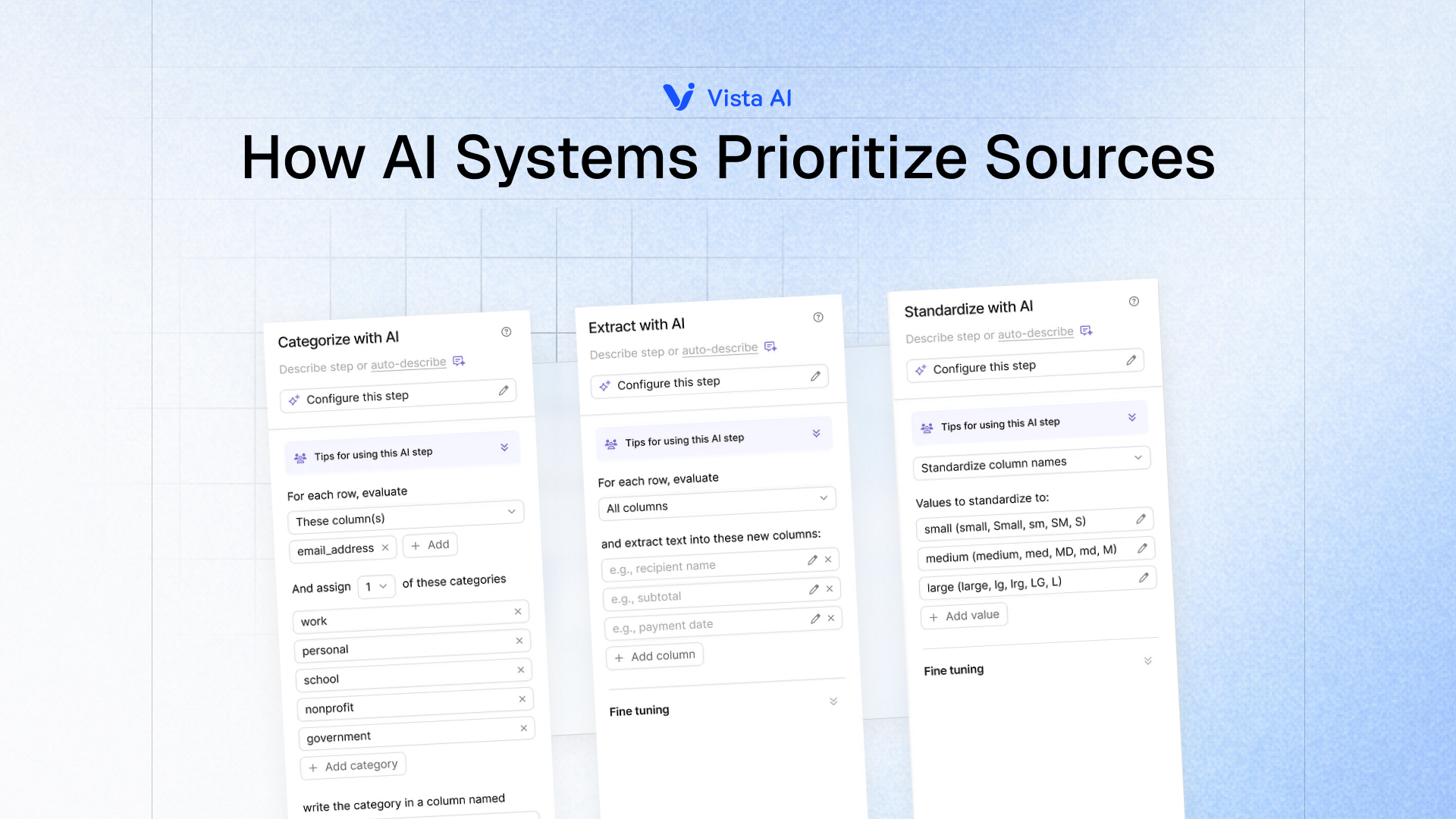
Not all AI systems cite sources the same way. Claude prioritizes different signals than ChatGPT. Perplexity's citation patterns differ from Gemini's. Your brand might be heavily cited by one AI system while barely appearing in another. Vista AI's AI Rank Tracker allows you to see which systems are citing you and where you're performing well or poorly. Understanding these differences is crucial for optimizing your visibility strategy because you can't rank uniformly across all systems—instead, you need to understand each system's preferences and create content that resonates with the systems that matter most for your business.
The variation exists because each AI system has different training approaches, different citation algorithms, different design philosophies, and different priorities. Some systems prioritize recent sources, others prioritize authority. Some reward citations to original research, others cite aggregated sources. Some prefer publisher verification, others prioritize directness. Understanding these differences and tailoring your approach accordingly can dramatically improve your visibility across the systems that drive the most qualified traffic to your brand.
This chapter breaks down the citation preferences of major AI systems and offers strategies for optimizing across multiple platforms while maintaining consistent brand messaging.
ChatGPT's Citation Patterns and Optimization Strategy
ChatGPT, the market leader in conversational AI, has particular patterns in how it cites sources. ChatGPT prioritizes authority and brand recognition, citing well-known publications, established brands, and sources with high topical authority. When ChatGPT answers questions, it often defaults to citing sources that readers would recognize and trust.
ChatGPT also shows strong preference for content that specifically answers the question being asked. If someone asks "what is agile project management," ChatGPT will cite sources that directly explain agile project management, not sources that mention agile tangentially. This means your content must directly address common questions in ways that are hard to miss. Foundational content that clearly defines core concepts has higher citation likelihood in ChatGPT.
For enterprise and business-related topics, ChatGPT citations skew heavily toward established business publications, consulting firms, and well-known companies. If you're a growing brand trying to compete for citations against Fortune 500 companies in business topics, you need to build sufficient authority signals that ChatGPT recognizes you as credible alternative sources. This often means earning press coverage, backlinks from major publications, and demonstrating customer trust through social proof.
ChatGPT's training data has a knowledge cutoff, and it doesn't always cite the most recent sources. If you're operating in a space where information changes rapidly, focus on becoming the foundational source on core concepts that don't change, while emphasizing recency for time-sensitive topics. Content published recently on evergreen topics might not be cited as frequently as established sources because ChatGPT's training data still heavily weights older authoritative content.
To optimize for ChatGPT citations, focus on becoming an authority that ChatGPT recognizes as trustworthy. Build brand authority through consistent high-quality content, third-party validation, and presence in major publications. Create content that directly answers common questions with exceptional clarity. Implement proper schema markup so ChatGPT can easily extract information from your content. If you're a newer brand, prioritize earning press coverage and backlinks from established publications—these signals build the credibility ChatGPT factors into citation decisions.
Claude's Citation Preferences and Strategy
Claude has notably different citation patterns than ChatGPT. Claude shows strong preference for original sources, comprehensive content, and sources that transparently acknowledge limitations or complexity. Claude is more likely to cite a blog post that thoughtfully explores nuance than a source that makes simple claims. This creates opportunities for newer brands to compete with established players by providing deeper analysis and more nuanced perspectives. Original research is particularly valued by Claude.
Claude prioritizes content that directly cites its sources and provides evidence for claims. If your content includes citations, data references, and clear evidence trails, Claude is more likely to cite you. This incentivizes creating well-researched content with visible sourcing, not marketing content that makes claims without backing them up.
Claude also shows preference for content that acknowledges complexity and trade-offs rather than oversimplifying. When your content discusses how something isn't universally applicable, what situations it's best for, and what limitations exist, Claude recognizes this nuance and trusts the source more. This is somewhat unique among AI systems—Claude's design prioritizes honesty over marketing polish, and this influences citation patterns.
To optimize for Claude citations, focus on creating comprehensive, well-researched content that acknowledges complexity and includes evidence for claims. Don't shy away from nuance—create content discussing why answers depend on context, what different approaches work for different situations, and what limitations exist. Include citations in your content that reference authoritative sources. Use clear structured data but also make sure your content reads as thoughtfully written, not automatically generated.
Claude also shows preference for content from subject matter experts. If your author is an established voice in your domain, Claude is more likely to cite them. Invest in building author authority alongside brand authority. Create author bios that clearly establish expertise, have consistent authors publish on specific topics, and gradually build author recognition as domain experts.
Perplexity's Citation Strategy and Search-Centric Approach
Perplexity positions itself as a search-focused AI, and its citation patterns reflect this. Perplexity cites more aggressively than other systems, often citing multiple sources for the same answer. This creates more citation opportunities overall—a single answer might include 5-10 citations where ChatGPT might include 2-3.
Perplexity also shows strong preference for sources that rank well in traditional search. Brands that have invested in SEO and have high search visibility often get cited by Perplexity, even if they haven't specifically optimized for AI. This is because Perplexity weights search authority signals into its citation decisions. If you rank well for relevant keywords in Google, you're more likely to be cited by Perplexity.
Perplexity rewards recency more heavily than some other systems. Newer content on trending topics has higher citation likelihood. If you're in a rapidly evolving space, publishing frequently about emerging trends and recent developments increases your chances of Perplexity citations.
To optimize for Perplexity, maintain strong traditional SEO alongside AI optimization. Build high-quality backlinks that improve your search authority—these signals carry over to Perplexity citations. Create content addressing emerging trends and breaking developments in your space. Ensure your site architecture makes it easy for Perplexity to crawl and discover your content. Since Perplexity cites more aggressively, being discoverable to Perplexity is particularly valuable.
Google's AI Overviews and Emerging Citation Patterns
Google's AI Overview (launched in 2024) has different dynamics than standalone AI systems. Google prioritizes its own search results and trusted third-party sources. Google is unlikely to cite questionable sources or content from small brands without significant authority signals.
Google's AI Overview shows strong preference for content that ranks well in traditional Google search, content from brands Google already trusts, and content from news outlets and established publications. This creates a bootstrapping challenge for newer brands—Google trusts sources it already knows, and those are typically sources that already rank well.
Google also weights YMYL (Your Money, Your Life) criteria more heavily than other AI systems. For health, financial, legal, and safety-critical topics, Google's AI Overview strongly prefers citing expert sources, established institutions, and verified professionals. If you're operating in YMYL categories, building professional credentials and third-party verification is essential.
To optimize for Google AI Overview citations, focus on building search authority through traditional SEO. Get your content ranking well in Google Search—this is a prerequisite for AI Overview citations. For YMYL topics, include clear credentials, expert verification, and professional endorsements. Build relationships with established publications and industry organizations that Google trusts.
Gemini's Balanced Approach to Source Evaluation
Google Gemini (the AI assistant with broader capabilities) has a balanced approach to citations that blends elements of other systems. Gemini values both authority and comprehensiveness. It cites established sources but also rewards deep, comprehensive content that goes beyond what established sources have published.
Gemini shows preference for content that's specifically optimized for AI discovery. Proper schema markup, clear structure, and machine-readable information enhance Gemini citations. This suggests that technical optimization has outsized impact on Gemini visibility compared to some other systems.
Gemini also cites content across different formats more evenly than some competitors. If you've created video content, PDF guides, or interactive tools alongside written content, Gemini is more likely to cite across these formats. This creates opportunities to diversify content types while maintaining citation visibility.
To optimize for Gemini, combine traditional authority building with technical optimization. Implement comprehensive schema markup. Create multi-format content on important topics—written guides, videos, interactive tools. Build search authority but also focus on AI-specific optimization. Gemini rewards brands that take both traditional and AI-optimized approaches seriously.
Niche and Specialized AI Systems
Beyond the major players, specialized AI systems are emerging for healthcare, finance, and other verticals. These systems have specific domain priorities and citation patterns tailored to their industries.
Healthcare AI systems prioritize medical credentials, clinical evidence, and established healthcare institutions. If you're operating in healthcare, building relationships with medical institutions, publishing evidence-based content, and earning credentials matter tremendously for specialized system citations.
Finance AI systems prioritize regulatory compliance, institutional credibility, and professional designations. Finance companies need to build credentials through industry certifications, regulatory compliance, and relationships with established financial institutions.
To optimize for niche AI systems, understand what domain-specific credentials and authorities matter in your space. Build relationships with leading institutions and experts in your domain. Create content that meets domain-specific standards for evidence and expertise. Consider whether specialized AI systems serving your industry offer better opportunities than general-purpose systems.
Creating a Multi-System Citation Strategy
Rather than trying to optimize uniformly for all systems, develop a tiered strategy focused on systems that matter most for your business. Start by understanding where your target customers interact with AI systems. If your customers use Claude extensively, prioritize Claude optimization. If Perplexity is their preferred search experience, invest there. Learn more in our comprehensive guide to multi-platform AI visibility strategy.
For each important system, understand its citation preferences and create specialized content addressing those preferences while maintaining core message consistency. Your foundational content and core messaging should remain consistent across systems, but emphasis and approach can vary. Content optimized for Claude can emphasize nuance and comprehensive analysis, while Perplexity-targeted content can emphasize recency and searchability.
Monitor your citations across different systems using Vista's AI Rank Tracker and brand visibility dashboard to track AI visibility by platform. See which systems are citing you most frequently and in what contexts. Use this data to inform strategy—if you're getting strong Perplexity citations but missing Claude, adjust your approach to address Claude's preferences.
Build authority gradually by establishing credibility across multiple systems. An article that gets cited by all major systems represents massive authority investment compounding across platforms. Focus initially on systems most important to your business, then expand to others as you develop consistent citation patterns.
Competitive Intelligence Across Systems
Analyze which sources your competitors are getting cited by across different AI systems. If a competitor dominates Claude citations but you dominate Perplexity, understand what's different about your approaches. Use this analysis to inform strategy refinement.
Track how different systems cite the same content differently. The same blog post might get heavy citations from one system while being ignored by another. Understanding these patterns tells you where your content strategy resonates and where it needs adjustment.
Conclusion
Success in AI visibility requires understanding that different systems have different citation preferences. Rather than pursuing generic AI optimization, develop nuanced strategies addressing each major system's particular preferences and priorities. The brands that understand these differences and build content strategies addressing them will capture disproportionate citation share across platforms. Ready to implement a multi-system strategy? Check our comprehensive implementation roadmap for guidance. Those treating all AI systems as identical will find their content underperforming because it's optimized for systems it isn't likely to influence. Understanding and adapting to system-specific citation preferences is how forward-thinking brands will dominate AI visibility.