Most teams find their AI visibility problem the same way: someone asks ChatGPT for "the best [our category] tools," and a competitor comes up first. Sometimes it's a competitor that's smaller, newer, or worse.
The obvious follow-up questions are hard to answer without a method. How often does this happen? On which platforms? For which topics? And why them and not us?
This guide gives you a repeatable framework for answering those questions: how to pick competitors, build a benchmark prompt set, calculate comparable metrics, and turn the gaps into a prioritized plan.
Step 1: Define Your AI Competitor Set (It's Not the Same as Your SEO Competitors)
Your competitors in AI answers are whoever the model names when buyers ask your questions. That list often differs from your sales team's list or your SEO competitor list.
Find them this way:
- Run 10 broad category prompts ("best X for Y," "alternatives to [market leader]," "top X tools 2026") on ChatGPT, Perplexity, and Gemini.
- List every brand named.
- Rank them by how often they appear.
You'll usually find three groups:
- Direct competitors: the expected names.
- AI-native surprises: brands that are small in traditional search but appear often in AI answers, usually because of strong third-party coverage or very clear positioning.
- Adjacent players: broader platforms the model recommends as a "you could also use..." option.
Benchmark against 3–6 of them. Include at least one AI-native surprise. They tend to show you the most about what's working.
Step 2: Build a Benchmark Prompt Set by Intent
A fair benchmark needs prompts that reflect how buyers actually ask questions, spread across the funnel:
| Intent | Example prompts | What it measures |
|---|---|---|
| Category discovery | "Best [category] for small teams" | Who gets shortlisted |
| Use case / problem | "How do I [job your product does]?" | Who's seen as the expert |
| Comparison | "[Competitor A] vs [Competitor B]" | Whether you're added to comparisons you weren't asked about |
| Alternatives | "Alternatives to [market leader]" | Your challenger position |
| Attribute | "Cheapest [category] with [feature]" | Whether your differentiators are recognized |
| Branded | "Is [brand] good for [use case]?" | How each brand is described |
Aim for 30–60 prompts, grouped into topics (for example "pricing," "integrations," "enterprise," "for agencies"). Topic grouping is what turns a benchmark into a gap analysis.
Step 3: Run the Prompts Across Platforms, More Than Once
The same prompt gives different answers on ChatGPT, Perplexity, Gemini, Copilot, Claude, and Google AI Overviews. A competitor can lead on Perplexity and be absent in Gemini.
Run every prompt on every platform you care about, and repeat each run several times (or weekly over a month). Single runs produce noisy, misleading comparisons.
Step 4: Calculate Four Comparable Metrics
For each brand, on each platform and topic:
1. Mention rate
answers naming the brand ÷ total answers
2. Share of voice (SOV)
brand mentions ÷ all brand mentions in the set
This is your headline competitive number. If you have 12% SOV and the leader has 31%, the gap is now something you can measure.
3. Average position
For list-style answers, the brand's average rank. Being named fifth out of five is very different from being named first.
4. Citation share
citations to the brand's domain ÷ all citations
This shows whose content the AI uses as evidence, which is often the cause of mention gaps.
Optional fifth metric: sentiment/framing. Is each brand recommended outright, listed neutrally, or mentioned with caveats ("but it can be expensive")?
Step 5: Build the Gap Matrix

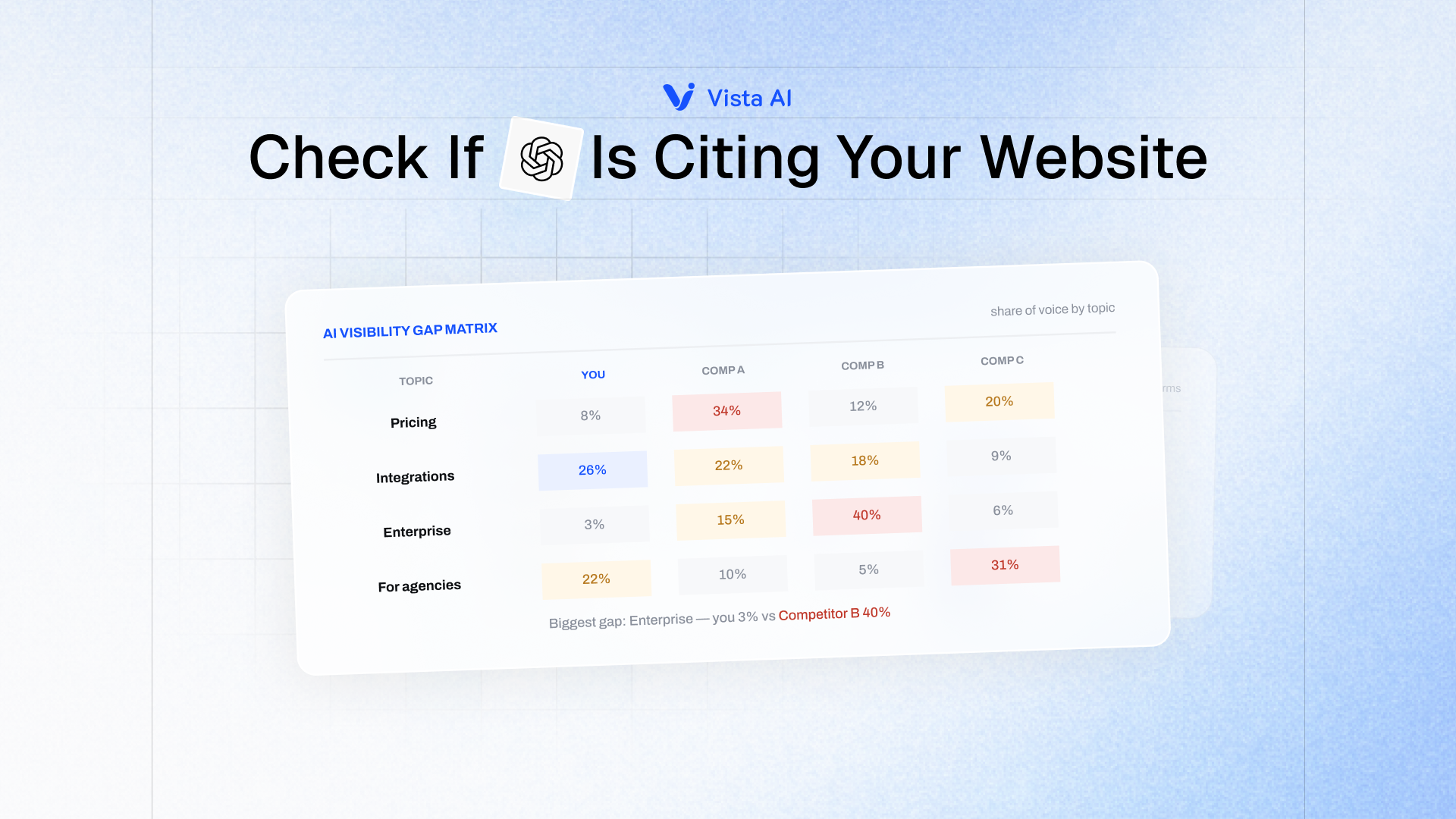
Put topics in rows and brands in columns, with share of voice in each cell:
| Topic | You | Competitor A | Competitor B | Competitor C |
|---|---|---|---|---|
| Pricing / affordability | 8% | 34% | 12% | 20% |
| Integrations | 26% | 22% | 18% | 9% |
| Enterprise / security | 3% | 15% | 40% | 6% |
| For agencies | 22% | 10% | 5% | 31% |
Gaps show up in three forms:
- Topic gaps: Topics where a competitor dominates and you barely appear (enterprise above).
- Platform gaps: You're competitive on Perplexity but missing on ChatGPT, or the other way round.
- Position gaps: You're named, but always last.
Step 6: Diagnose Why the Competitor Wins
This step separates a benchmark from a to-do list. For each important gap, pull the cited sources behind the competitor's mentions. You'll usually find one of five causes:
1. They have a page that answers the question and you don't.
If the AI cites the competitor's "Enterprise Security Overview" page for enterprise prompts and you have no equivalent, the fix is clear.
2. Third-party sources favor them.
If the AI cites listicles, review sites, Reddit threads, or analyst write-ups that feature the competitor and leave you out, you have a coverage gap. See our guide on third-party listicles and earned media.
3. Their positioning is stated more clearly.
Models repeat what's stated plainly. If the competitor's site says "the project management tool built for agencies" and yours says "work management for modern teams," the model has an easier time matching them to agency prompts.
4. Their content is easier to extract.
Clear headings, direct answers near the top, comparison tables, and FAQ sections are easier to quote than long narrative pages.
5. Technical access.
Sometimes the gap is simply that your site blocks AI crawlers or renders key content with JavaScript that bots can't read.
Step 7: Prioritize the Gaps
Not every gap is worth closing. Score each one on:
- Commercial value: How close is this topic to a purchase?
- Gap size: The difference in share of voice.
- Effort: One new page vs. a six-month PR campaign.
- Volatility: Topics where you appear sometimes (unstable visibility) are cheaper to win than topics where you never appear.
Start with high-value, unstable topics, where you're already a plausible answer and the competitor's lead is thin.
Step 8: Re-Benchmark Monthly
AI answers change as models update, new content is published, and competitors respond. Re-run the same prompt set monthly, keep the history, and watch for:
- Gaps closing after your content launches
- New competitors entering answers
- Sudden drops after model updates
Leadership will ask for this trend line, so build it from the first month.
Doing This Manually vs. With a Tool
You can run a small benchmark (20 prompts × 3 platforms × 4 competitors) by hand in a spreadsheet. Past that size, the number of checks gets unmanageable.
Vista AI's Competitor Analysis automates the whole workflow. It tracks your prompt set across ChatGPT, Perplexity, Gemini, Claude, Copilot, and Google AI Overviews, calculates share of voice and citation share for you and your competitors, and shows which sources are behind each competitor's visibility. That way you see both the gap and its cause.
See exactly where competitors are beating you in AI search. Start for free with Vista AI