Introduction
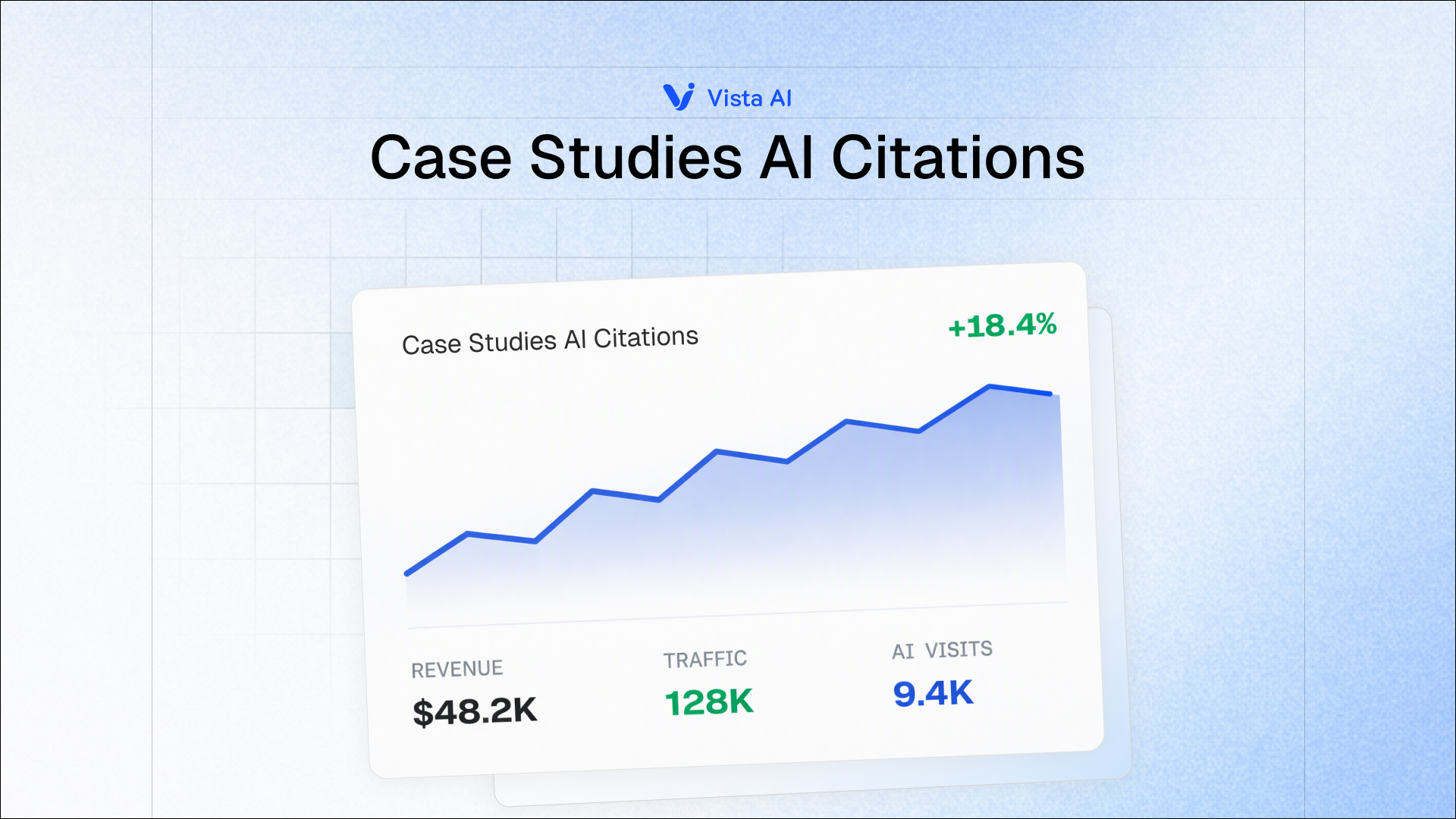
Among all content types, case studies generate citations in AI systems at rates that far exceed other formats. This isn't accidental. AI systems are evaluating sources based on demonstrated expertise and proof of results. Vista AI's platform helps you track which of your case studies are being cited and measure their business impact. A well-constructed case study tells a story that shows expertise in action—how you understood a customer's problem, what solution you provided, and what measurable results they achieved. That proof-based narrative is exactly what AI systems need to confidently recommend your solutions.
For many brands, case studies are an afterthought—something you create when a customer agrees to share their story, then file away in a case study section that few people visit. But in AI visibility strategy, case studies should be central. They're your most powerful citation-generating asset because they address questions AI systems need answered before recommending anything: does this actually work? Have other people used this successfully? What kind of results did they get?
The challenge is that most case studies are written as marketing collateral rather than as content AI systems want to cite. They're overly polished, light on details, and structured to close sales rather than educate readers. AI visibility demands a different approach—case studies written as educational content that happens to showcase your capabilities, not marketing content dressed up as a story.
Why AI Systems Cite Case Studies More Frequently
When someone asks Claude about implementing a complex system or solving a specific business problem, Claude wants to cite examples that demonstrate the approach working in practice. A blog post explaining "best practices for sales process optimization" is educational. A case study showing how a company transformed their sales process using specific approaches and achieved 40% faster deal closure is proof. AI systems increasingly distinguish between theoretical guidance and proven approaches, and they cite proven approaches more readily.
Case studies work because they provide three things AI systems value above almost everything else: expertise demonstration, risk reduction for the buyer, and specificity. An implementation guide can teach someone how to do something in theory. A case study proves someone has actually done it, solved unexpected problems, and achieved quantified results. This reduces buyer risk by showing that real people have successfully done what the AI is recommending.
The specificity also matters enormously. General guidance like "improve your password security practices" gets cited less frequently than "how a financial services company strengthened password requirements to meet compliance while reducing support burden by 35%." The specific example, with concrete details and quantified results, is what AI systems cite when answering real questions from real people with specific needs.
Additionally, case studies have natural distribution advantages. Customers featured in case studies will share them with peers, prospects will send them to stakeholders, sales teams will use them in conversations. This distributed social proof signals to AI systems that the content is valuable and trustworthy. Content that generates word-of-mouth is often content worth citing.
The Anatomy of a High-Citation Case Study
Not all case studies generate citations equally. The structure, detail level, and focus matter tremendously. Case studies that get heavily cited follow a specific structure that helps AI systems extract the most relevant information. For the technical side of making case studies citation-ready, review our guide on schema markup and citation optimization.
Begin with a clear challenge statement that many potential customers recognize. Instead of starting with client name and industry, start with the problem. Many organizations struggle with X, or face constraints like Y and Z. This context helps AI systems understand whether this case study is relevant to the question being asked. A prospect asking about sales acceleration needs to know immediately that your case study addresses that problem.
After establishing the challenge, introduce the specific customer context. What industry were they in? How large was the organization? What specific constraints did they face? This section should establish that the customer is comparable to the people asking questions in AI systems. If your case study is about a Fortune 500 company's implementation, it should be clear that this applies to enterprises specifically, not all companies.
The heart of a strong case study is the solution narrative—not as a feature list, but as a story of how the customer actually implemented your solution. What was the implementation process? What challenges came up that weren't anticipated? How did you solve unexpected problems? How did the customer need to change their processes to make this work? This narrative section is crucial because it demonstrates expertise in real-world application, not theoretical perfection. AI systems value this authentic explanation of implementation complexity and problem-solving.
Crucially, include honest discussion of trade-offs and limitations. What didn't work as expected? What did the customer need to do differently than they initially thought? What were the constraints or limitations they had to work within? This honesty makes the case study far more valuable for AI citation because it demonstrates that you're not overselling outcomes and that you understand the complexity of real implementations.
The results section should include specific, quantified metrics. Instead of "significant improvement," provide actual numbers. "Reduced customer support tickets by 42%," "improved project delivery time from 18 weeks to 12 weeks," "increased customer retention rate from 78% to 91%." Quantified metrics are what AI systems need to cite when explaining outcomes to prospects asking about potential results.
Finally, include key learnings or methodology that goes beyond this specific customer. What did you learn from this implementation that applies broadly? What patterns might other organizations recognize? This section positions the case study as educational content, not just a sales story. AI systems increasingly cite case studies for their learnings and methodologies, not just their outcomes.
Structuring Case Studies for Different Customer Types
Your most valuable case studies will address your most common customer segments. But don't create one generic case study attempting to address everyone. Instead, create specific case studies for each major segment you serve, highlighting how your solution fits each segment's unique needs and constraints.
For enterprise customers, case studies should emphasize scale, integration complexity, security requirements, and long-term ROI. Enterprises want to see that you've successfully implemented with organizations of comparable size, managed complex integrations with existing systems, maintained security standards, and delivered measurable business value that justified the investment. These case studies should be more detailed about implementation timelines and change management because enterprises care about how long adoption takes and how many resources you'll need.
For mid-market customers, focus on growth acceleration, team scaling, and business transformation. Mid-market leaders want to see that you've helped similar companies scale operations, improve efficiency as they grow, and compete better. These case studies should emphasize rapid implementation (mid-market can't sustain 6-month rollouts), team enablement, and immediate impact.
For small business and startup customers, emphasize simplicity, cost-efficiency, and operational impact. Small teams want to see that you've helped businesses get more done with limited resources, that implementation is straightforward, and that the solution fits their fast-moving culture. These case studies should highlight quick wins and rapid time-to-value.
For different industry verticals, create case studies specific to each industry. Healthcare, finance, manufacturing, nonprofits, and education each have unique regulatory requirements, workflow patterns, and priorities. When an AI system is answering a question from someone in healthcare, it wants to cite healthcare-specific examples, not generic ones. A single healthcare case study will generate more citations than three general case studies to the healthcare buyer.
Mining Your Customer Base for Case Study Opportunities
Many brands claim they don't have case study opportunities when in reality they have dozens that they haven't surfaced. Great case study prospects aren't just customers with impressive metrics—they're customers with interesting stories, clear challenges they overcame, and willingness to discuss specific details.
Start by identifying your highest-value customers—not by contract size, but by engagement depth and success indicators. These are customers who adopted quickly, used your solution comprehensively, and achieved measurable results. They're also likely to be passionate about what you helped them accomplish.
Within your customer base, look for interesting variations. Customers using your solution in unexpected ways, customers who overcame significant challenges through your product, customers in high-profile industries, customers who scaled dramatically after implementing. These variations create differentiated case study stories that showcase different aspects of your expertise.
The ideal case study customer is one willing to discuss specifics. You can work around customers who need anonymity, but named case studies generate more citations because AI systems can verify the source. When a case study is attributed to "TechCorp Inc., a mid-market financial services firm," AI systems know the company is real and can verify the claim if needed. This verifiability increases citation likelihood.
Reach out to potential case study customers with a specific value proposition. Explain that you'd like to collaborate on a detailed guide to their implementation that shares best practices with their industry peers. Frame it as an opportunity to position them as thought leaders in their industry, not as promotion for your company. Many customers are willing to participate when they understand the content will genuinely help their industry peers.
The Implementation Process for Case Study Development
Developing strong case studies requires dedicated process and expertise. Assign someone to own case study development—ideally someone who is both a good writer and understands your product deeply. This person should interview customers, extract stories, and write narratives that balance detail with accessibility.
Start with a structured customer interview. Ask about the situation before they found you. What problem were they trying to solve? What had they tried before? What made the challenge difficult? Move through their journey with you—what prompted them to consider your solution, what made them choose you, what was their implementation experience? Then focus on results and learnings—what changed, what was unexpected, what did they learn, what would they do differently in hindsight?
Record the interview so you can capture direct quotes. The most powerful case studies include customer voice—direct quotes expressing their challenges, experiences, or results. This authenticity makes case studies far more compelling for AI citation.
After the interview, draft the case study and share it with the customer for feedback. Focus on accuracy and factual verification. Make sure metrics are exact, timelines are correct, and they're comfortable with what you've written. Request specific details and examples that might feel minor but are crucial for making the case study authoritative.
Once finalized, promote the case study across multiple channels. Feature it on your website. Include links in relevant blog posts. Share it in industry discussions. Include it in sales conversations and presentations. The more visible a case study is, the more likely AI systems will encounter and cite it. Well-distributed case studies get cited more frequently because AI crawlers are more likely to discover them.
Measuring Case Study Impact on AI Visibility
Track which case studies generate citations using Vista's AI citation tracking and AI Rank Tracker tools. Our brand visibility dashboard shows exactly where your case studies are being cited. Identify which case studies are cited most frequently, in which AI engines, and in what contexts. This data reveals whether your case study strategy is working and what resonates most. Learn how to calculate the ROI of your case studies to justify continued investment in this high-leverage format.
Look for patterns. Are case studies from specific industries cited more frequently? Are certain types of customer success stories cited more often? Do case studies from well-known brands get cited differently than others? Use these patterns to inform future case study strategy and customer selection.
Correlate case study citations with sales impact. When prospects encounter your case studies in AI systems, do they convert differently than prospects who haven't seen them? Do leads who've read case studies have higher deal values or shorter sales cycles? This business impact measurement is what ultimately justifies the effort invested in case study development.
Finally, monitor how competitors are using case studies. What case study opportunities are they capturing that you're missing? What story angles are they using that resonate with AI systems? Use this competitive intelligence to stay ahead in case study strategy.
Conclusion
Case studies are the highest-leverage content format for AI visibility when structured properly. They provide exactly what AI systems need to make confident recommendations: proof that your solution works in practice, detailed understanding of implementation, quantified results, and authentic customer perspective. The brands that systematically develop case studies across their major customer segments and actively promote them will see disproportionate citation growth. See how case studies fit into your overall 90-day AEO roadmap and why they're critical in phase three. Those case studies won't just drive citations—they'll drive qualified leads from AI systems, because prospects encountering your case studies are already convinced that your solution works. The only question is whether it's right for their specific situation.